Summary
Across manufacturing and distribution, a quiet contradiction is taking shape.
Most B2B organizations have invested heavily in operational excellence. Enterprise Resource Planning (ERP) systems run factories efficiently, manage inventory precisely, and keep finance and logistics tightly controlled. From the inside, the business appears optimized.
Yet customers are leaving.
Not because products are inferior. Not because pricing is uncompetitive. But because the buying experience feels outdated, slow, and disconnected.
This is the core conflict facing modern B2B organizations: the back office has been optimized, while the customer experience has been left behind.
ERP systems are designed for efficiency, control, and consistency. Growth, however, depends on experience. When customer interactions are shaped primarily by internal systems rather than customer needs, friction accumulates in places leadership rarely sees.
To compete in the next decade, B2B leaders must stop treating eCommerce as a thin digital layer on top of ERP. The future belongs to organizations that create a true digital marriage, where operational truth and customer experience operate in continuous alignment.
Introduction
For more than two decades, B2B success followed a familiar formula. Optimize operations. Standardize processes. Reduce inefficiencies. Control costs. Companies that executed well on these fundamentals outperformed their peers.
Enterprise Resource Planning systems became the backbone of this strategy. They unified finance, inventory, procurement, and fulfillment into a single operational truth. For manufacturers and distributors, ERP investment was not optional. It was survival.
And it worked. Internally.
What changed was not the importance of operational excellence, but the expectations surrounding it. Customers began to assume that internal efficiency would translate into external simplicity. When it did not, frustration followed.
Today, many B2B organizations face an uncomfortable reality. Their internal systems are stronger than ever, yet customer satisfaction and loyalty feel increasingly fragile. Orders are fulfilled correctly, but the experience feels slow. Data is accurate, but access feels constrained. Service is reliable but not effortless.
This gap is not caused by broken technology. It is caused by outdated assumptions about where relationships are formed and maintained in modern B2B commerce.
eCommerce is no longer a digital brochure or a secondary channel. It has become the primary interface of the customer relationship. It is where trust is reinforced, expectations are set, and long-term loyalty is quietly built or lost.
And this gap is redefining who wins and who disappears in B2B.
Table of Contents
Why ERP Was Never Built for Customer Experience

For decades, the ERP has been the undisputed center of the B2B technology stack. It is rightly considered the single source of truth. Inventory accuracy, pricing logic, tax rules, credit limits, and fulfillment workflows all live there.
The problem begins when the ERP is expected to serve as the primary interface for customers.
ERP’s Internal Bias: Built for Control, Not Customers
ERP systems were never designed to win customers. They were designed to protect the business.
Accountants depend on them for financial accuracy. Warehouse managers rely on them to control inventory movement. Operations teams use them to standardize workflows. Procurement officers trust them to enforce approvals and policies. Every interface decision reflects these priorities.
Efficiency, control, and compliance come first.
When these same interfaces are exposed to customers, friction follows. What feels logical to an internal user feels opaque to an external buyer. Terminology reflects internal processes rather than customer intent. Navigation mirrors organizational structure instead of buying behavior.
In effect, customers are asked to navigate an internal filing system.
This is why ERP-native portals feel dense, jargon-heavy, and unintuitive. They require explanation rather than discovery. Training rather than intuition. Patience rather than confidence.
This is not a failure of ERP design. It is a misuse of ERP purpose. Systems built to govern operations rarely succeed as systems meant to guide experience.
The Buyer Expectation Shift Toward Digital Self-Service
Buyer expectations have changed, and they are not reverting.
Research highlighted by McKinsey on the B2B digital inflection point shows a decisive shift toward digital self-service across the buying journey. Modern buyers expect to research, configure, price, transact, and track digitally, on their own terms.
This shift is not about age. It reflects the normalization of digital convenience. Buyers compare their B2B experiences not just to competitors, but to the best digital experiences they encounter anywhere.
When these buyers are forced into clunky ERP-driven portals or manual workflows, the friction is not neutral. It sends a signal.
It suggests that internal efficiency matters more than customer time. That convenience is conditional. That autonomy is limited.
Buyers do not argue. They disengage.
The Engine Without Wheels

An ERP is a powerful system. It contains the logic, data, and controls required to run a complex business. But power alone does not create growth.
If the ERP is the high-performance engine of the organization, it often sits idle when it comes to customer experience. Without a mechanism to translate that power into motion, operational excellence remains trapped inside the business.
eCommerce provides that mechanism.
It turns inventory accuracy into confidence. Pricing logic into trust. Fulfillment discipline into reliability.
Without eCommerce, customers never feel efficiency. They only feel friction.
With eCommerce, efficiency becomes visible. Experience becomes scalable. Growth becomes a function of alignment rather than effort.
ERP-Centric vs Customer-Centric: The Experience Gap
Dimension | ERP-Centric Reality | Customer Expectation (eCommerce-Led) |
|---|---|---|
Design Intent | Built for internal control and governance | Built for external ease and self-service |
Primary Users | Accountants, operations, warehouse, procurement | Buyers, procurement teams, sales reps |
Interface Logic | Mirrors internal processes and terminology | Mirrors customer intent and buying flow |
Learning Curve | Requires training and explanation | Designed for intuition and speed |
Response to Friction | Users adapt because they must | Buyers disengage and look elsewhere |
Signal Sent to Customer | “Work the way we work” | “We respect your time” |
Role in Growth | Maintains operational stability | Converts efficiency into momentum |
Analogy | High-performance engine | Wheels that move the business forward |
Outcome Without Balance | Power without motion | Motion without friction |
Why B2B Commerce Is About Relationships, Not Transactions

B2C commerce is often transactional. Loyalty is shallow and price-driven.
B2B commerce is different.
It is ongoing, contractual, and embedded in daily operations. Customers depend on suppliers not just for products but for continuity and predictability.
Where B2C resembles first dates, B2B resembles long-term partnerships.
The Core Promises That Define B2B Relationships
Every successful B2B relationship is built on a small set of implicit promises. These promises are rarely written down, but they are always felt.
Accuracy Customers expect to see real inventory and realistic availability. Not estimates. Not placeholders. What is shown must reflect what can actually be delivered.
Reliability Negotiated pricing, contract terms, and fulfillment commitments must be honored consistently. Any deviation, even accidental, erodes confidence quickly.
Attentiveness Customers expect their history to be remembered. Past orders, preferences, and buying patterns should inform future interactions, not be rediscovered repeatedly.
Sales teams make these promises through conversation and relationship-building. Digital systems are responsible for keeping them, consistently and at scale.
When systems fail to uphold these promises, the relationship weakens regardless of intent.
What “Enchanting” Means in a B2B Context
In B2B, “enchanting” does not mean flashy design or consumer-style gimmicks. It means making complex relationships feel simple to manage.
Industry leaders demonstrate this clearly.
Grainger offers an example. Behind the scenes sits one of the most complex ERP-driven catalogs in industrial distribution. On the surface, customers experience intuitive bulk ordering, saved lists, and fast reordering that feels closer to retail than procurement.
In both cases, the complexity has not been removed. It has been translated.
This is the essence of B2B trust. It is not emotional. It is operational, contractual, and repeatable.
Designing for Scale: Separating Foundation from Interface
Modern B2B digital success depends less on individual tools and more on how responsibilities are divided between them.
When systems are allowed to specialize, they scale. When they are forced to overlap, complexity and fragility increase.
At the heart of sustainable digital architecture is a simple principle:
The system that governs truth should not be the system that presents it.
This principle clarifies the distinction between ERP and eCommerce.
ERP as the Brain, eCommerce as the Face
The ERP functions as the brain of the organization. It governs operational truth and enforces the rules that keep the business coherent. Inventory levels, pricing logic, tax calculations, credit limits, and fulfillment workflows belong here because they require precision, consistency, and compliance.
The eCommerce platform functions as the face. It communicates that operational truth to customers in a way that is understandable, usable, and actionable. Its role is not to decide what is true, but to make what is true easy to work with.
This separation is not philosophical. It is practical.
Systems optimized for governance prioritize stability and control. Systems optimized for interaction must be flexible, fast, and forgiving. When one system is forced to do both, neither performs well.
Why Separation Prevents Friction
When ERP logic dictates the customer interface, usability suffers. Changes become slow. Every adjustment carries operational risk.
When eCommerce platforms attempt to invent or override operational rules, accuracy suffers. Trust erodes.
A sustainable architecture allows each system to excel in its role while remaining tightly aligned.
The table below illustrates why attempting to merge these responsibilities creates friction rather than efficiency:
Dimension | ERP (The Brain) | eCommerce (The Face) |
|---|---|---|
Core Role | Governs operational truth | Communicates that truth to customers |
Primary Purpose | Control, accuracy, and compliance | Clarity, usability, and engagement |
Data Ownership | Inventory, pricing logic, tax rules, credit limits | Presentation of prices, availability, and offers |
Decision Authority | Enforces business rules | Interprets rules into customer actions |
Interface Design | Functional, process-driven | Intuitive, branded, experience-driven |
Performance Priority | Data integrity and stability | Speed, responsiveness, and ease of use |
Change Tolerance | Low, changes carry operational risk | High, optimized for iteration and UX improvement |
Failure Impact | Financial and operational disruption | Friction, confusion, or lost engagement |
Best Use Case | Running the business |
The Architectural Payoff
When this separation is respected, several things happen simultaneously:
This is how ERP and eCommerce stop competing for control and start reinforcing the relationship.
And that reinforcement is what turns transactions into durable B2B partnerships.
How Digital Self-Service Strengthens Sales Teams

Digital transformation often triggers resistance from sales teams, and the concern is understandable. For decades, access to information was part of the salesperson’s value. Pricing, availability, order status, and product details flowed through human interaction.
When self-service enters the picture, it can feel like that value is being taken away.
In reality, something very different is happening.
What Self-Service Actually Removes: Low-Value Sales Work
A modern eCommerce experience does not replace sales representatives. It replaces repetition.
Reorders, invoice lookups, shipment tracking, and price confirmations are necessary tasks, but they do not create growth. They consume time, fragment attention, and limit how many accounts a salesperson can meaningfully manage.
When these tasks shift to self-service, sales teams gain capacity rather than losing relevance.
That capacity is not theoretical. It shows up as fewer interruptions, fewer reactive emails, and fewer calls driven by missing visibility. Instead of acting as human APIs for basic information, sales representatives regain control of their time.
From Order Takers to Account Owners
Once routine work is removed, the role of sales changes in a meaningful way.
Sales representatives move from processing transactions to owning accounts. Conversations shift from “Can you place this order?” to “How can we help you consolidate spend, reduce downtime, or plan your next project?”
This is where real value is created.
Advisory selling requires context, continuity, and trust. It requires sales teams to understand customer history, purchasing patterns, and future needs. These are precisely the activities that get crowded out when sales time is dominated by repetitive service work.
Digital self-service does not eliminate relationships. It protects them by removing the noise that prevents them from deepening.
One Source of Truth, One Experience
Gartner’s concept of the Digital Sales Room reinforces this evolution. When customers and sales teams operate from the same real-time data, the experience becomes coherent rather than fragmented.
Pricing seen online matches pricing discussed on calls. Inventory availability is consistent across channels. Order history is visible to both sides. There is no need to reconcile versions of the truth.
Whether the customer interacts through a screen or a conversation, the promise remains the same.
This consistency strengthens trust. It also strengthens the salesperson’s credibility. Instead of explaining discrepancies or correcting errors, sales teams can focus on guidance, strategy, and growth.
Why This Model Scales Better
Self-service does not reduce the importance of sales. It changes where sales effort is applied.
As customer expectations for speed and autonomy rise, organizations that rely entirely on human mediation struggle to scale. Sales teams become bottlenecks rather than accelerators.
By contrast, organizations that pair self-service with advisory sales create leverage. Each salesperson can support more accounts, more strategically, without sacrificing quality.
In this model, digital and human channels do not compete. They reinforce each other.
Self-service handles the routine. Sales handles the relationship.
That is how digital self-service strengthens sales teams instead of replacing them.
The Four Most Common Causes of ERP–eCommerce Failure
Most ERP–eCommerce initiatives do not fail because the technology is incapable. They fail because of structural decisions made early in the project that compound over time.
Fragile Point-to-Point Integrations
Point-to-point integrations connect one system directly to another with custom logic on both sides. They often appear fast and cost-effective at the start.
In practice, they become brittle.
Every ERP upgrade, eCommerce platform update, or workflow change introduces risk. A small modification in one system can silently break the connection in another. Over time, teams become afraid to change anything because the integration is unpredictable.
What begins as a shortcut becomes a constraint.
As complexity grows, maintenance costs rise and innovation slows. Instead of enabling growth, the integration becomes something the business works around.
ERP-Driven Interface Decisions
Another common failure occurs when ERP logic dictates the customer experience.
Because the ERP contains the rules, teams often assume it should define how information is presented. The result is a customer interface shaped by internal processes rather than customer intent.
Customers are forced to think like your operations team. Product structures mirror internal categories. Terminology reflects back-office language. Workflows follow approval logic instead of buying behavior.
The site may be accurate, but it is not usable.
When usability suffers, adoption drops. Customers revert to calling or emailing, undermining the very purpose of eCommerce.
Poor Underlying Data Quality
eCommerce platforms amplify whatever data they are given.
If pricing rules are inconsistent, inventory data is outdated, or customer records are fragmented, the storefront exposes those issues instantly and at scale.
Errors that were previously hidden behind manual processes become visible to every customer. Confidence erodes quickly when prices change unexpectedly, inventory appears unreliable, or order histories are incomplete.
This is not a front-end problem. It is a data governance problem.
Without disciplined data ownership and cleanup, digital experiences accelerate dissatisfaction rather than reducing it.
Unclear Ownership Between IT and Sales
ERP–eCommerce projects often fail organizationally before they fail technically.
When ownership is unclear, decisions stall. IT optimizes for system stability. Sales optimizes for customer convenience. Without a shared mandate, compromises frustrate both sides.
The site becomes a political battleground rather than a growth engine.
Changes take too long. Accountability is diffuse. When issues arise, responsibility shifts rather than resolves.
Successful digital commerce requires shared ownership. IT safeguards the foundation. Sales shapes the experience. Both are accountable for outcomes.
Why These Failures Matter
Each of these issues increases operational risk and customer confusion on its own. Together, they compound.
Customers lose trust. Internal teams lose confidence. Leadership loses patience.
ERP–eCommerce success is not about adding features. It is about avoiding these structural traps and designing for alignment from the beginning.
Organizations that address these causes early do not just avoid failure. They create digital systems that scale with confidence rather than caution.
The Virtina Approach: Harmonization Over Connectivity
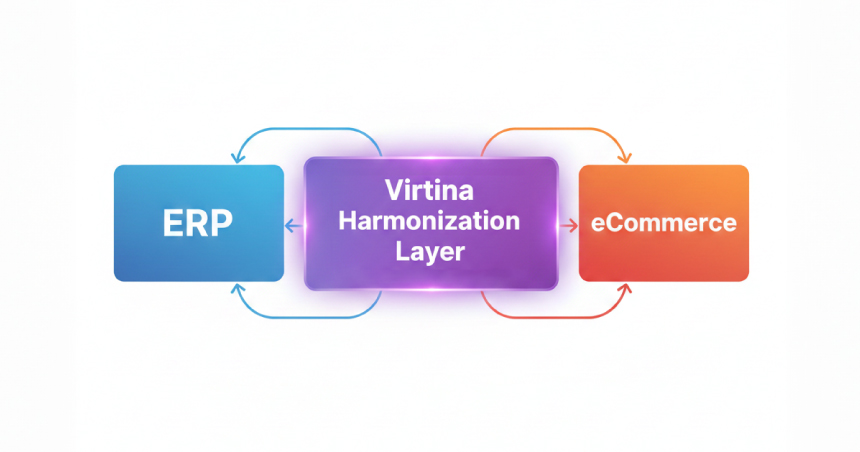
Most ERP–eCommerce initiatives fail not because the technology is inadequate, but because the problem is defined incorrectly from the outset.
Too often, integration is treated as a connectivity task. Systems are connected, data is exchanged, and the project is declared complete. From a technical standpoint, it works.
From a business standpoint, it does not.
Connection without alignment does not produce a usable digital experience. It produces a fragile one.
At Virtina, integration without harmonization is treated as a structural failure point. Two systems can exchange data flawlessly and still deliver a broken customer experience if pricing rules, inventory logic, customer hierarchies, and ownership boundaries are misaligned.Fix Operational Truth Before Designing the Experience
Virtina begins every ERP–eCommerce engagement with a back-office audit.
Before interface design or UX decisions are made, the operational reality of the business is mapped and validated. This includes pricing tiers, warehouse-specific availability, tax exemptions, customer-specific rules, fulfillment constraints, and exception handling.
This step is essential because eCommerce does not simplify complexity. It exposes it.
Any inconsistency that once required internal explanation becomes visible to every customer immediately and at scale. What was previously managed through emails or sales calls becomes a public signal of reliability, or lack of it.
Virtina’s approach ensures that what is promised digitally can be delivered operationally without manual intervention. The objective is not to eliminate complexity but to translate it into a form customers can understand, trust, and act on confidently.
Complexity is not removed. It is translated.
Integration Architecture That Scales With Growth
Point-to-point integrations often appear attractive early in a project. They seem faster to implement and easier to reason about.
Over time, they become liabilities.
As businesses evolve, pricing logic changes, warehouses are added, customer contracts grow more complex, and traffic increases. Each change places new strain on tightly coupled integrations. Small adjustments introduce unexpected failures. Over time, teams become reluctant to change anything at all.
Innovation slows. Risk accumulates.
Virtina avoids this trap by prioritizing harmonization over direct coupling.
The ERP remains authoritative as the system of record. It governs truth, rules, and enforcement. The eCommerce platform remains expressive as the system of interaction. It focuses on usability, speed, and clarity.
Integration ensures both systems operate from a shared operational language in real time, without forcing either system to behave outside its intended role.
This separation allows each platform to evolve independently without breaking the relationship between them. Updates become manageable. Scale becomes predictable. Growth does not introduce instability.
Alignment as a Competitive Advantage
When ERP–eCommerce alignment is done correctly, the impact extends beyond technology.
Sales teams trust the digital channel. Customers trust what they see. IT teams avoid constant firefighting. Leadership gains confidence that digital growth will not compromise operational integrity.
This is the difference between an integration that technically functions and one that actually supports the business.
Virtina avoids failure not by adding complexity, but by respecting the purpose of each system and ensuring they remain in continuous alignment. That is how ERP and eCommerce stop working against each other and begin reinforcing the relationship.
How ERP and eCommerce Should Exchange Data in Practice
Successful ERP–eCommerce integration is defined by flow, not endpoints.
Real-Time, Bidirectional Data Flow
When inventory changes in the warehouse, customers see it. When customers place orders or request quotes, the ERP records it.
No re-entry. No lag.
This model aligns with common enterprise commerce architectures where the ERP remains the single source of operational truth and the eCommerce layer reflects that truth consistently across customer touchpoints. Synchronizing pricing, inventory, and customer hierarchies is critical to preserving trust as volume and complexity increase.
Protecting ERP Performance as Demand Scales
To prevent customer traffic from degrading financial and operational systems, Virtina implements middleware that manages load, orchestrates data exchange, and shields the ERP from unnecessary strain.
This allows digital channels to scale without compromising the stability of the systems that run the business.
The strongest ERP–eCommerce architectures are not defined by how tightly systems are connected but by how clearly responsibilities are separated and synchronized. Alignment, not connectivity, is what scales.
Conclusion
In modern B2B commerce, efficiency is no longer a differentiator. It is expected.
ERP systems keep the business running. eCommerce experiences determine whether customers stay.
Organizations that treat digital experience as secondary will discover that operational excellence alone does not protect them from churn. Those that align operational truth with customer experience build relationships that scale.
If your ERP runs the business, your eCommerce experience must run the relationship. Is your digital ecosystem in a healthy marriage, or is it headed for divorce? If you’re ready to bridge the gap between your back office and your customers, take our B2B eCommerce Maturity Assessment to discover exactly where your organization stands and what steps will move you forward. Virtina is here to architect your success.