Summary
An ecommerce website redesign usually costs $3,000 to $12,000 for a small store, $10,000 to $40,000 for a mid-market store, and $50,000 to $200,000 or more for a large B2B or enterprise build. The price follows scope: catalog size, integrations, custom features and platform. This article shows what drives the number, which costs are easy to miss, and how to set a budget before you ask for quotes.
Introduction
Ask three agencies what a redesign costs and you may get three very different numbers. That is not always padding. The quotes often cover different things: one includes redirects, testing and training, another leaves them out.
A store with 200 products and a standard checkout is a different project from one with 20,000 SKUs, an ERP connection and customer-specific pricing. This guide gives realistic ranges by project type, explains what pushes the price up, and shows how to judge cost against return. If you are still deciding whether to redesign at all, start with how an outdated store hurts conversions.
Table of Contents
- How much does an ecommerce website redesign cost?
- What drives the cost of an ecommerce redesign?
- What costs are missing from the first quote?
- How long does a redesign take, and how should you budget?
- How can you control redesign cost without cutting corners?
- How Virtina prices a redesign
- People also ask
- Conclusion
- Frequently asked questions
How much does an ecommerce website redesign cost?
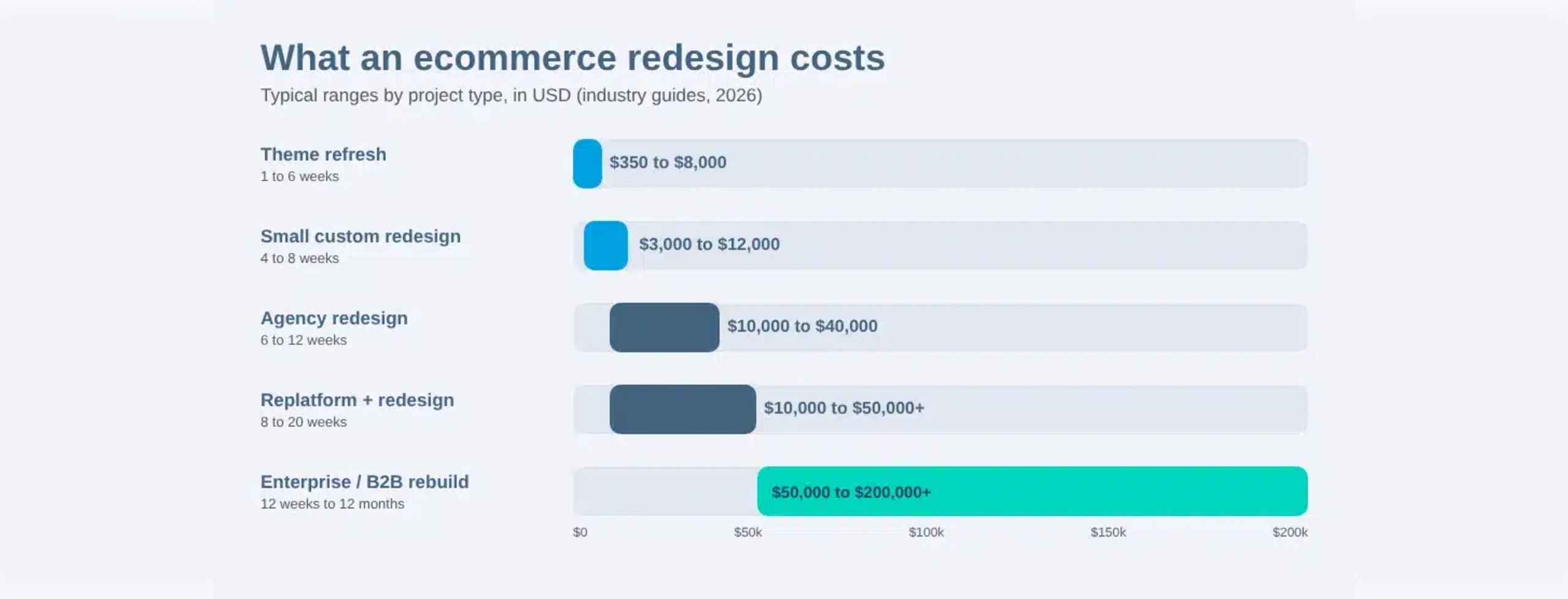
Most redesigns fall into five bands, and the band you land in depends on how much of the store has to change underneath the design. The table below places your project. These are industry ranges compiled from published 2026 pricing guides, not Virtina quotes, so use them to orient yourself rather than to price a job.
What do the bands mean in practice?
- Refresh. A new theme on the same structure. Fast and cheap, but it does not fix checkout, search or data problems.
- Custom redesign. New layouts, new product and category templates, and a reworked checkout, built on the platform you already use.
- Replatform plus redesign. The design work plus a full data migration, which is where most budgets stretch.
- Enterprise or B2B rebuild. Business logic, integrations and account features dominate the cost, not the visual design.
How does the platform change the price?
On Shopify, published guides put template-based work at $3,000 to $12,000, mid-market custom builds at $12,000 to $40,000, and Shopify Plus or complex migrations at $40,000 to $150,000 or more. For WooCommerce, freelancer-led redesigns typically run $3,000 to $12,000, and agency work follows the mid-market and enterprise bands above. Published ranges for Magento (Adobe Commerce) are scarce. These projects tend to land in the upper rows because of larger catalogs and heavier integrations.
Our Shopify vs WooCommerce comparison covers running costs, which matter as much as the build price. If you are planning a new store rather than a redesign, see how to calculate the cost of building an ecommerce website.
What drives the cost of an ecommerce redesign?
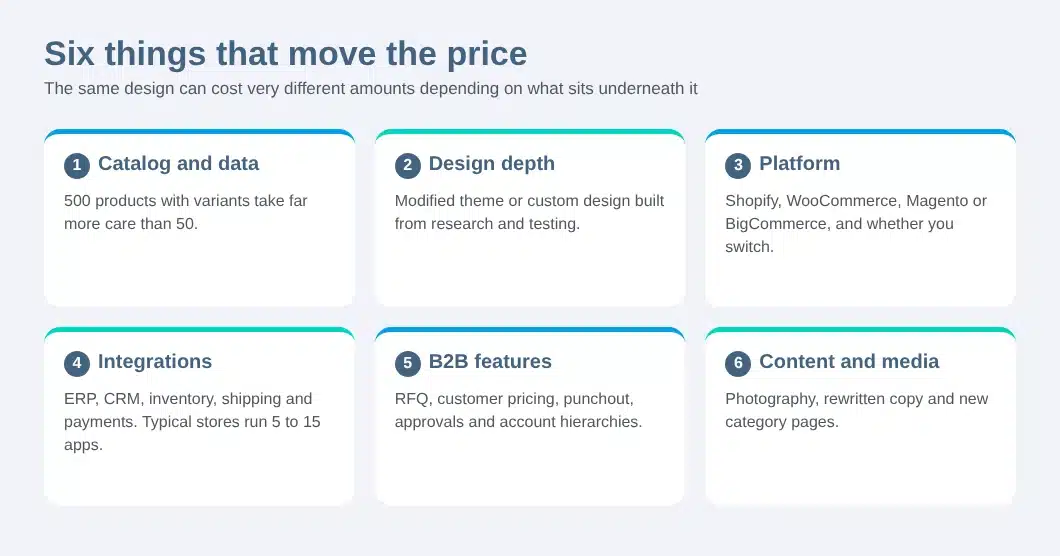
Six factors explain most of the gap between a $10,000 quote and a $100,000 one. Knowing them lets you tell an agency what is in scope before it prices the work.
Catalog size and data complexity
Moving 500 products with variants and attributes takes far more care than moving 50. Every product, category and image has to land on the right page with the right data.
Design depth
A modified theme costs a fraction of a custom design built from research, wireframes and tested layouts. Custom work also needs more rounds of review.
Integrations
Every connection to an ERP, CRM, inventory system, shipping tool or payment gateway has to be rebuilt or re-tested on the new store. Industry guides put typical stores at 5 to 15 connected apps, and each one adds scope.
B2B and custom functionality
Quoting and RFQ flows, customer-specific pricing, punchout, account hierarchies and approval workflows are custom work on most platforms. They are the main reason B2B redesigns sit in the top rows of the table.
Content and media
New product photography, rewritten copy and new category pages add real cost when existing assets are not good enough to carry over.
Protecting your search traffic
Redirect maps, structured data and launch checks usually cost a few thousand dollars on an ecommerce site, which is small next to a ranking drop. We cover the details in why ecommerce sites lose rankings after a redesign.
What costs are missing from the first quote?
Published pricing guides estimate that overlooked items add 15 to 25 percent to the initial quote. Ask every agency whether these are included or billed separately, so you can compare quotes line by line.
What changes in the running costs after launch?
Platform and app subscriptions, and hosting, continue after the build is paid for. A cheaper build on a platform with high monthly fees can cost more over three years than a pricier build on one with low fees. Compare total cost over three years, not the build price alone.
How long does a redesign take, and how should you budget?

Most standard redesigns take 8 to 12 weeks from audit to launch. Larger B2B stores with ERP integrations usually take 12 to 16 weeks. A timeline that stretches usually costs more, because the team is billed for the extra time.
How do you judge cost against return?
A redesign pays for itself when the added revenue is larger than the total cost. As an illustration only, a store earning $1,000,000 a year whose conversion rate rises from 1.5 percent to 1.8 percent at the same traffic gains about $200,000 a year. Your numbers will differ, so use your own revenue, traffic and conversion rate.
How do you set a ceiling before asking for quotes?
Estimate the added revenue over 12 to 24 months using the lowest lift you can defend, then subtract the running costs. What remains is the most the project can cost and still make sense. Share the ceiling and the scope with each agency so the quotes are comparable.
How can you control redesign cost without cutting corners?
Five habits keep a redesign on budget without trading away the parts that protect revenue.
- Start with an audit. You pay to fix what is actually costing sales rather than redoing everything.
- Keep the platform unless it is the real problem. Replatforming is the largest single cost multiplier.
- Prepare content and product data before kickoff. Late copy and photography are a common cause of overruns.
- Agree scope in writing. Put new ideas on a phase two list, not into the current build.
- Launch in phases if the budget is tight. Do the templates that drive revenue first (home, category, product page, cart, checkout) and secondary pages later.
The cheapest quote is rarely the lowest cost. A redesign that skips testing, redirects or performance work often needs a paid fix within months, and that fix tends to cost more than doing it properly the first time.
How Virtina prices a redesign
We do not publish fixed prices, because two stores with the same page count can have very different integrations and data. We start with a free redesign audit, then give a fixed quote for the agreed scope.
If you want a rough number first, try our ecommerce cost calculator. To see what happens at each stage, read our five-step redesign process, or review our ecommerce website redesign services.
People also ask
Is a redesign cheaper than a rebuild?
Usually yes, when the platform and data stay the same. A rebuild or replatform adds migration, testing and integration work, which is why those projects sit in the higher rows of the table.
Why do agency quotes for the same store differ so much?
Quotes differ in scope, not just price. One may include redirects, testing, accessibility and training while another leaves them out, so compare line by line.
Is a template redesign good enough?
It can be, for a small catalog with a standard checkout. It will not fix slow pages, weak search or a checkout that loses orders, because those sit below the theme.
Conclusion
An ecommerce redesign can cost a few thousand dollars or well into six figures. The difference comes from catalog size, integrations, custom features and platform, not from how polished the design looks.
Set a ceiling from the revenue you expect to gain, ask every agency to quote the same scope, and check what each quote leaves out. That keeps the budget honest from the first conversation.
Frequently Asked Questions
How much does it cost to redesign a small ecommerce website?
Most small stores land between $3,000 and $12,000, depending on whether they use a template or a custom design and how many products and integrations they have.
How long does an ecommerce redesign take?
Standard projects take 8 to 12 weeks, and larger B2B stores with ERP connections take 12 to 16 weeks.
What should a redesign quote include?
At minimum: design, development, data migration, redirects, testing, performance work, training and a launch plan. If any of these are missing, ask whether they are billed separately.
Can I spread the cost by redesigning in phases?
Yes. Launch the pages that drive revenue first (home, category, product, cart and checkout) and schedule secondary pages for a later phase.
Will a redesign hurt my SEO?
It can if URLs, titles and structured data are not carried over. Plan for it from the start with our guide to keeping rankings through a redesign.
Virtina builds and rebuilds stores on WooCommerce, Magento, BigCommerce and Shopify. Tell us about your store and we will review it, point out what is costing you sales and give you a fixed quote. Book a free call to get started.
Pricing ranges are compiled from 2026 guides by Web Cost Estimator, KrishaWeb and Clutch, checked October 5, 2026.