Summary
Successful platforms are all about innovative, scalable, and customer-driven approaches.
They succeed through cutting-edge innovations, seamless user experiences, and responses to changing needs.
Explore the platforms this blog mentions for inspiration or shopping needs to see their standout features and strategies.
eCommerce has grown exponentially to become one of the cornerstones of modern shopping.
It has reshaped how people find, buy, and get their products.
With consumers becoming more accustomed to digital convenience, global eCommerce sales are expected to surpass 8 trillion dollars, growing by a robust 39%. This steady growth shows an increasing dependence on online sites and the scope of business operations to succeed in this digital market.
When you think about the various eCommerce sites in play today, identifying which aspects contribute to the success of the more successful ones helps businesses decide about resource allocation.
This blog breaks down the leading websites that set the future course of eCommerce and their features that are transforming the way the eCommerce industry works.
Table of Contents
This page ranks the top 10 online shopping sites in the world by one metric: total monthly website visits, Semrush Traffic Analytics, July 2026. It then covers eleven more eCommerce websites that lead a category or a country.
Every figure here carries its source and its period. Where a number could not be confirmed against a primary source, it is not on the page.
That rule removed several familiar claims, including the market-size figure this page used to open with. A number with no date and no named source is decoration, not evidence.
The ranking also has a real blind spot, and this page states it rather than hiding it. Web-visit panels do not count app traffic, which is why Taobao, Tmall, JD.com and Pinduoduo are absent.
Below the ranking sit the same companies by disclosed revenue, the regional and category leaders, and what any of it changes for a store you actually run. If you are here to benchmark your own build, the must-have store features are a better starting point.
How this ranking is measured
This ranking uses one metric: total monthly website visits, Semrush Traffic Analytics, July 2026. Every figure was read from the same panel, in the same month, one domain at a time.
One company gets one flagship storefront domain. Amazon’s country sites are counted separately by Semrush, so they are not stacked into a single total.
What is excluded and why
Only shopping destinations qualify. Three kinds of site are kept out, and the rule is worth stating plainly because it changes the list.
- Commerce software. Shopify sells store software, not products. It is not a place a shopper buys a thing.
- Single-brand manufacturer stores. samsung.com drew 407.2M visits in July 2026 on Semrush Traffic Analytics, more than Etsy. It is still one brand selling its own goods, and apple.com is out for the same reason.
- Food delivery. A restaurant delivery service answers a different question than this one.
Naming the number you are excluding is what makes an inclusion rule credible. Samsung would sit sixth on visits. It is out because the rule says so, not because it is awkward.
If you read this page before, Apple, Shopify and DoorDash are gone. That rule is why.
Top 10 online shopping sites in the world
Ranked by monthly website visits in July 2026, the top 10 online shopping sites in the world are Amazon, Temu, AliExpress, Walmart, eBay, Etsy, Rakuten, Shein, Coupang and Ozon.
Every figure below comes from one source on one metric in one month: Semrush Traffic Analytics, total monthly website visits, July 2026. Nothing else is used to order this list.
| Rank | Site | Owner or parent | Home market | Monthly visits, Jul 2026 |
|---|---|---|---|---|
| 1 | Amazon (amazon.com) | Amazon.com, Inc. (Nasdaq AMZN) | United States | 2.42B |
| 2 | Temu (temu.com) | PDD Holdings Inc. (Nasdaq PDD) | China origin, United States is the largest market at 38.87% of visits | 1.25B |
| 3 | AliExpress (aliexpress.com) | Alibaba Group | China, cross-border | 699.81M |
| 4 | Walmart (walmart.com) | Walmart Inc. (NYSE WMT) | United States | 562.88M |
| 5 | eBay (ebay.com) | eBay Inc. (Nasdaq EBAY) | United States, global | 556.74M |
| 6 | Etsy (etsy.com) | Etsy, Inc. (Nasdaq ETSY) | United States, global | 372.66M |
| 7 | Rakuten (rakuten.co.jp) | Rakuten Group, Inc. (TSE 4755) | Japan, 97.31% of visits | 347.66M |
| 8 | Shein (shein.com) | Shein Group, HQ Singapore, listed Hong Kong 00625 | Global, China supply chain | 321.71M |
| 9 | Coupang (coupang.com) | Coupang, Inc. (NYSE CPNG) | South Korea, 94.31% of visits | 253.78M |
| 10 | Ozon (ozon.ru) | Ozon Holdings | Russia | 230.94M |
Ranked by total monthly website visits, Semrush Traffic Analytics, July 2026, data updated 12 August 2026. One flagship domain per company. Web visits only, app traffic is not counted.
Ozon takes tenth place on the metric, not on usefulness
Ozon holds the tenth slot because the metric puts it there. It drew 230.94M monthly visits in July 2026 on Semrush Traffic Analytics.
Almost none of that audience is reachable by a US or EU brand. We are leaving it in anyway, because a ranking you edit for comfort is not a ranking.
Quietly swapping in a friendlier name is what most pages on this query do. You cannot check a list that has been tidied for taste.
Just outside the top 10
Flipkart and Mercado Libre are the two near-misses most likely to matter to you. Flipkart drew 224.37M monthly visits in July 2026, with 94.36% of them from India.
Walmart has majority-owned Flipkart since 2018, so two rows in that table share a parent. Mercado Libre drew 221.18M visits in the same month and leads Brazil and Latin America.
Both are more useful to most readers of this page than the tenth-placed site. Any plan that leans on a single one of them carries real marketplace dependency risk.
Why Amazon’s country storefronts are counted separately
Amazon.com’s 2.42B does not include amazon.de, amazon.in or amazon.co.uk. Semrush counts each country domain on its own, and so does this table.
In July 2026 amazon.de drew 435.13M visits, amazon.in 299.59M and amazon.co.uk 276.46M. Amazon.fr had 174.16M, amazon.ca 170.97M and amazon.es 166.61M.
Three of those would rank inside this top 10 by themselves. Stacking them into one row would make Amazon look bigger and the comparison worse.
1. Amazon

The largest online store in the world, Amazon offers exceptional customer service and an amazing selection.
What began as an online bookstore has evolved into a one-stop store for cloud computing services, apparel, electronics, and food.
It is through features such as one-click ordering, fast delivery through Prime, and AI-driven recommendations that Amazon is thriving.
The Amazon Marketplace is an access platform to millions of customers and is a superpower for eCommerce entrepreneurs.
2. Temu
Temu is the second most-visited shopping site on earth, at 1.25B monthly visits in July 2026 on Semrush Traffic Analytics. Its parent is PDD Holdings Inc., Nasdaq PDD, which also owns Pinduoduo.
Temu began commercial operations in 2022, per PDD Holdings’ Form 20-F. Reaching half of Amazon’s web traffic inside four years is the fastest build on this page by a wide margin.
The United States is its largest market at 38.87% of visits, and that is the part operators keep missing. For a US brand, Temu is not a China story. It is a price-anchor story.
If your category has a cheap equivalent on Temu, your customers have already seen it. That does not mean you compete on price. It means your product page has to justify the gap.
3. AliExpress
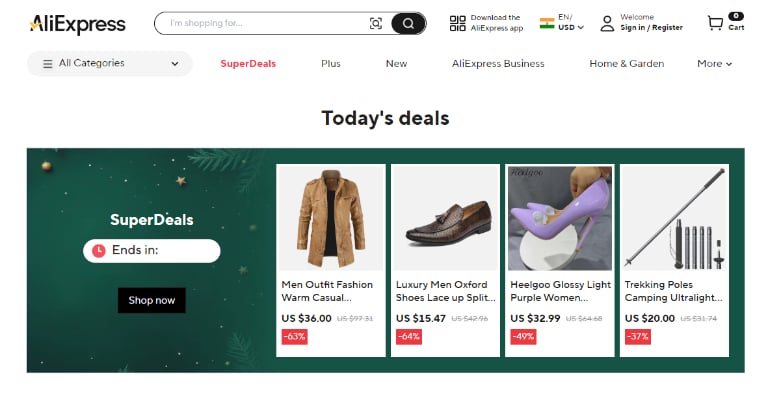
AliExpress is a well-known brand that enables you to purchase goods at a reasonable cost anywhere globally.
It also offers exceptional cross-border trade since it links buyers and sellers from other nations, frequently directly from manufacturers.
This makes it perfect for dropshipping and entering foreign markets because the firms can source goods at cheaper prices.
Overall, AliExpress is a household name in international eCommerce because of the variety of products, cost-effectiveness, and shipping convenience.
4. Walmart

Walmart has significantly marked eCommerce through seamless online and offline shopping integration.
Known for its “Everyday Low Prices,” Walmart uses the extensive network of its physical stores to enhance digital offerings.
The features like free curbside pickup, next-day delivery, and integration with Walmart+ have made it the favorite among value-conscious shoppers.
Walmart’s marketplace opens up a wide consumer base for sellers, thus making them benefit from a household name, but with the trust intact.
5. eBay
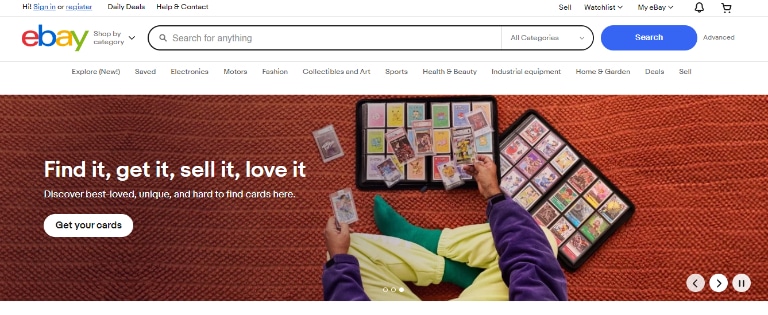
eBay is popular for its auction-style and peer-to-peer sales. Here, one can find a platform for both individuals and businesses.
From rare collectibles to everyday things, eBay connects buyers and sellers worldwide.
Its notable features include flexible pricing models, an auction or “Buy It Now,” strong seller tools, and a straightforward interface for small businesses.
For eCommerce businesses, eBay is the go-to marketplace for reaching niche audiences and building loyal customer bases.
6. Etsy
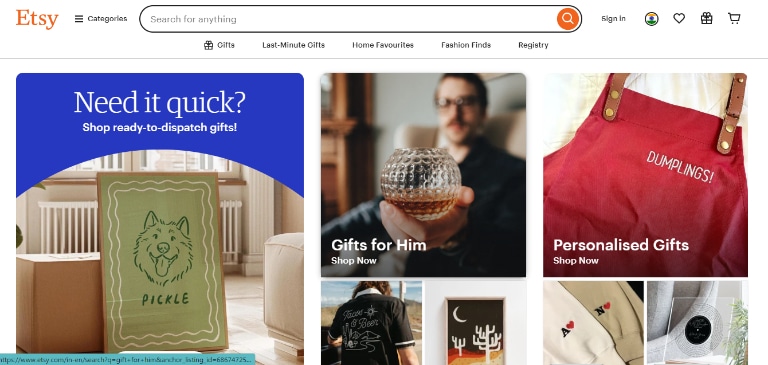
Etsy is an online go-to for artisans, crafters, and collectors.
The marketplace focuses on individuality and handmade, vintage, and rare items. This allows a small business and independent creator to connect with an international audience with a passion for unique, one-of-a-kind items.
For the eCommerce entrepreneur, Etsy has tools that help in branding, inventory management, and analytics to scale without losing authenticity.
It also encourages a sense of community through its seller forums and offers guidance and support for navigating the world of online retail.
7. Rakuten

Rakuten is Japan’s marketplace, and describing it as a cashback programme is a United States view of a Japanese company. Rakuten.co.jp drew 347.66M monthly visits in July 2026 on Semrush Traffic Analytics.
97.31% of that traffic comes from Japan. It is the most domestically concentrated site in this top 10, and still the seventh most-visited shopping site in the world.
Rakuten Group, Inc. trades in Tokyo as 4755. The marketplace sits alongside banking, mobile and travel businesses, and one loyalty currency runs across all of them.
The lesson for an operator is not the points programme. It is that a single-country marketplace can outrank global brands on traffic, which is worth holding in mind when you compare top eCommerce platforms for a market entry.
8. Shein

Shein has brought a storm to the fashion world by offering affordable fashion products while being driven by the trend.
Their model creates designs and produces items directly based on real-time consumer information, ensuring whatever they make is in fashion.
Its aggressive digital marketing, mainly through social influencers, has brought Shein to international stardom.
Shein has drawn in younger audiences while maintaining customer loyalty by concentrating on direct-to-consumer sales and adopting a mobile-first approach.
9. Coupang
Coupang is South Korea’s dominant shopping site, at 253.78M monthly visits in July 2026 on Semrush Traffic Analytics. Coupang, Inc. trades on the NYSE as CPNG.
94.31% of that traffic comes from South Korea. It is the second most concentrated entry in this top 10 and still one of the largest shopping sites in the world.
Coupang’s own fulfilment network is the reason it holds the market. Overnight delivery is the default expectation for Korean shoppers, not a paid upgrade.
That matters outside Korea too. Delivery expectations set in one market do not stay there, and a two-day promise reads slow to a shopper used to next morning.
10. Ozon
Ozon takes tenth place with 230.94M monthly visits in July 2026 on Semrush Traffic Analytics. It is Russia’s largest marketplace and is operated by Ozon Holdings.
For most readers of this page it is not a sales channel. Payments, logistics and sanctions rule it out for a US or EU brand.
So why is it here? Because the metric puts it here, and the whole point of stating a metric is that you then follow it.
Treat Ozon as a scale reference, not an opportunity. A regional marketplace can be enormous on traffic and irrelevant to your commercial plan.
Why the biggest sellers are missing from this list
The biggest sellers are missing because this ranking counts website visits, and Chinese commerce happens almost entirely inside apps. Taobao, Tmall, JD.com and Pinduoduo move enormous volumes of goods and barely register on a web panel.
This is not a rounding error. It is the difference between looking like a regional player and being one of the largest retailers on earth.
What the traffic numbers say about Taobao, Tmall and JD.com
Taobao showed about 60.78M monthly web visits in July 2026 on Semrush Traffic Analytics, at global rank 679. That is less web traffic than a mid-sized US retailer.
The readings for jd.com at about 20.33M and tmall.com at about 18.25M are low confidence. Both came back as June figures rather than clean July ones, and Semrush’s China panel coverage is thin.
Use those two numbers for one purpose only, which is to show the size of the gap. They are not JD’s audience and they are not Tmall’s. Pinduoduo has almost no consumer web storefront to measure at all.
Why a web-visit panel cannot see app-first commerce
A web-visit panel measures browser sessions, and the panels say so themselves. Wikipedia’s methodology note on its most-visited-websites list states that these rankings “do not account for app traffic”.
Chinese shopping is app-first by default, so the panel is pointed at the wrong surface. The mobile commerce statistics behind that shift show the same pattern spreading well outside China.
Taobao shows 60.78M monthly web visits. JD.com booked US$187.2B in net revenues in FY2025, per its investor release of 5 March 2026. Those two facts describe one market, and only one of them measures what people assume it measures.
This limitation applies to the table above on this page. It ranks by web visits because that is the only metric available on the same basis for all ten sites.
That same choice is why four of the largest sellers on earth are not in it. Read the ten as the most-visited shopping websites, not as the biggest sellers.
No other page answering this query says that out loud. At least one makes it worse. It lists app users for one site beside web visits for another. Those are not the same measure.
A ranking that admits what it cannot see is worth more than one that does not. That is the only reason to trust the ten above.
The same companies by disclosed revenue instead
This table switches metric completely. It reports company-disclosed figures from annual results and regulatory filings, not website visits.
Read it as a second view, not a correction of the first. It is not comparable with the visit figures and it is not what the ranking on this page is based on.
| Company | Figure | Period | Source |
|---|---|---|---|
| Amazon | Net sales US$716.9B | FY2025 | Amazon Form 10-K, SEC, filed February 2026 |
| JD.com | Net revenues US$187.2B | FY2025 | JD.com investor release, 5 March 2026 |
| Walmart | Global eCommerce sales US$150.4B | FY2026 | Walmart FY26 annual report, April 2026 |
| eBay | GMV US$79.6B | FY2025 | eBay Q4 and FY2025 results, February 2026 |
| Mercado Libre | GMV US$65B | FY2025 | MercadoLibre Q4 and FY2025 results |
| PDD Holdings (Temu and Pinduoduo) | Revenues US$61.75B | FY2025 | PDD Holdings Form 20-F, SEC |
| Shein | Net revenue US$41.8B | FY2025 | Disclosed in the Hong Kong listing process, reported 1 September 2026 |
| Coupang | Net revenues US$34.5B | FY2025 | Coupang Q4 2025 results, 26 February 2026 |
Company-reported figures from annual results and regulatory filings. Fiscal years differ by company. Net sales, net revenues and gross merchandise value are different measures and are not comparable with each other, or with the visit figures above. This table is not used to rank this list.
What changes when you switch metric
Two things. JD.com appears at all, having been absent from the visits table entirely. Temu’s parent, PDD Holdings, sits well down the order rather than second.
Be careful reading straight down the Figure column. Net sales, net revenues and GMV are three different things, and stacking them into one league table is the error this page exists to avoid.
The practical takeaway is simple. Traffic tells you where attention is, filings tell you where money is, and the two lists are not the same list.
Regional and category leaders worth knowing
These sites are not in the global top 10 and none of them is close. They are here because each one owns a category or a market well enough to set customer expectations inside it.
Read the group as category leaders, not as a continuation of the ranking. They are grouped by what they sell: big-box retail, home and pets, beauty, electronics, and resale.
Where a company fact could not be confirmed against a primary source, this page describes what the site sells and stops there. That restraint is deliberate, and it is why some entries carry no numbers at all.
Target

Target embraced digital transformation, emphasizing customer convenience features, including app-based shopping, same-day delivery, and curbside pickup options, that make it stand out among the best in omnichannel retail.
With a balance between affordable prices and trendy product lines, Target keeps appeal among various demographics.
Target is an online retailer looking to increase sales and client loyalty using technology and customer-focused tactics.
Wayfair

Wayfair is far superior to the competition in terms of furnishings and interior design.
Its extensive collection includes both high-end and low-cost styles.
Its user-friendly interface and interactive features, like 3D room planners and augmented reality previews, let customers picture things in their homes.
The delivery and assembly services offered by Wayfair guarantee prompt arrival and assist in eliminating the hassles involved in handling large objects.
Chewy

Chewy has changed the face of how pet owners shop for their pets.
With its superb customer service, Chewy provides extra miles of personalized touch through handwritten cards and product suggestions that cater to each customer’s needs.
The subscription model ensures regular delivery of pet essentials and allows pet owners to shop easily.
Chewy’s customer-first strategy can be learned from these eCommerce businesses.
Its proactive assistance, easy returns, and round-the-clock customer service show how building an emotional bond can result in enduring success and loyalty.
Sephora
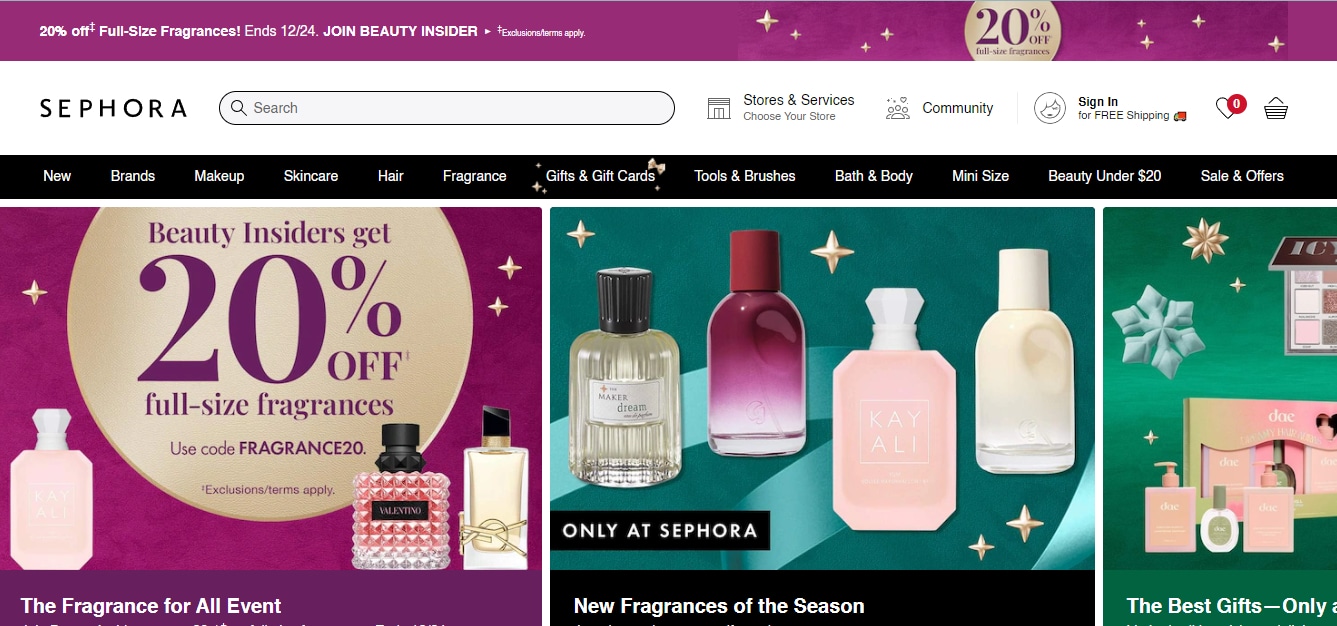
The foundation of Sephora’s supremacy in the cosmetics sector is innovation.
Their strong internet presence is complemented by an engaging mobile application and an excellent social media approach.
Features like virtual try-ons and AI-driven skincare consultations help customers make the most informed decisions while purchasing from the comfort of their homes.
In a way, Sephora exemplifies how technology can be woven with personalization for an eCommerce business.
Its “Beauty Insider” loyalty program is another great example of how reward systems can encourage repeat purchases and create community among customers.
StockX

StockX is like a stock exchange for collectibles, streetwear, and footwear.
Similar to buying and selling stocks, the site features a unique bidding system that allows buyers and sellers to negotiate at real-time prices.
Also, every product sold on this platform is authenticated, bringing trust to its audience.
By catering to a niche audience, this innovative approach for eCommerce proves that specialized platforms can find success by addressing specific customer passions.
ThredUp

ThredUp has become a market leader in used clothing with a growing consciousness about going green.
It allows sellers to list their pre-worn clothing, giving a window to quality items for less price-conscious buyers.
With increasing trends in circular economies, sustainability helps ThredUp compete against other secondhand sales.
A clean interface and extensive catalog make their website accessible and desirable for an expansive audience, proving that second-hand also becomes chic, scalable, and desirable.
Zappos

Known as the destination of choice for shoes, Zappos is an industry leader in merging niche expertise with unbeatable customer service.
This “WOW” philosophy shows through their lenient return policies, 24/7 customer support, and quick shipping.
For any eCommerce business, Zappos offers a master class in building brand loyalty through focusing on customer satisfaction and specialization.
Newegg

For technology fanatics, Newegg is like a mine of gold. It features electronics and computer parts coupled with its gaming gear.
The store has generated a devoted niche following for buying tech-related things, offering businesses an opportunity with seller programs, a focused audience, and marketing techniques such as daily deals.
Its emphasis on product-depth information and reviews from experts is what has separated the company from most others selling in niche marketplaces.
Best Buy

One feature of this site that stands out is its smoothness between the online and in-store buying experience.
The site lets consumers browse products online and have them shipped to their local Best Buy within hours, creating an eCommerce experience that brings a brick-and-mortar immediacy.
For eCommerce brands, Best Buy is a model example of how to offer flexibility and convenience.
Its value is added through its tech support services, especially the Geek Squad, which has further created loyal customers returning both for products and expertise.
What this means for your store
None of these sites is your competitor, and every one of them is your benchmark. Your customers arrive on your product page carrying habits built on Amazon, Temu and Coupang.
Search that finds things. Delivery dates that are specific. Returns that are not a negotiation.
That is a build problem, not a marketing one. You cannot message your way past a checkout that takes six steps.
Which expectations are actually worth matching
Not all of them. Copying Amazon’s fulfilment promise on a US$5M catalogue will drain your margin long before it converts anyone.
The ones worth matching are the cheap ones. Accurate stock counts, honest delivery windows, and a search box that finds your own products are configuration and data problems, not capital projects.
The ones worth ignoring are the ones funded by scale you do not have. Free returns on bulky goods is the usual trap.
When the answer is your platform, not your team
Sometimes the gap is not effort. If your platform cannot hold customer-specific pricing or ship a usable mobile checkout, no amount of tuning fixes it.
That is the point to work through the eCommerce platform selection factors properly, before anyone writes code. Most replatforming regret starts with skipping that step.
If the decision lands on a move, treat shopping cart migration as a data and URL problem first, and a design project second. Plan it in that order and you keep the rankings you already have.
People also ask
Is Temu bigger than Amazon?
No. Temu drew 1.25B monthly web visits in July 2026 against Amazon’s 2.42B, on Semrush Traffic Analytics.
On money the gap is far wider. PDD Holdings, Temu’s parent, reported US$61.75B in FY2025 revenues in its SEC Form 20-F, against US$716.9B in net sales in Amazon’s FY2025 Form 10-K.
Temu is much closer to Amazon on attention than on revenue.
Is Amazon bigger than Alibaba?
It depends which metric you use, and both answers are sourced. Amazon reported US$716.9B in net sales for FY2025 in its Form 10-K, several times Alibaba’s group revenue for its financial year ended 31 March 2026.
Alibaba’s own Form 20-F states that Alibaba is the largest retail commerce business in the world by gross merchandise value.
So Amazon leads on reported revenue and Alibaba claims the lead on GMV. Anyone giving you a single answer is picking a metric without telling you.
Which is the number 1 online shopping site in the world?
Amazon, on both metrics this page uses. Amazon.com drew 2.42B monthly visits in July 2026 on Semrush Traffic Analytics, roughly double the second-placed site.
Separately, Amazon reported US$716.9B in net sales for FY2025 in its Form 10-K. No other company on this page is close on either measure.
One caveat: that visit figure counts amazon.com alone, not amazon.de, amazon.in or any other country storefront.
What is the biggest online shopping site in China?
Alibaba’s marketplaces, Taobao and Tmall, on the company’s own account. Alibaba’s Form 20-F states it is the largest retail commerce business in the world by gross merchandise value.
JD.com is the largest of the Chinese players here by disclosed revenue, at US$187.2B for FY2025 in its investor release of 5 March 2026.
None of them looks large on web traffic. Taobao showed about 60.78M monthly web visits in July 2026 on Semrush Traffic Analytics, because Chinese shopping happens inside apps.
Conclusion
The honest answer to this question is a list plus a caveat. The list, by monthly web visits in July 2026, is Amazon, Temu, AliExpress, Walmart, eBay, Etsy, Rakuten, Shein, Coupang and Ozon.
The caveat is that web panels cannot see app-first commerce. Four of the largest sellers on earth are missing from this ranking, and from every ranking built the same way.
Most pages answering this query publish a number with no caveat, or a caveat with no number. Either one is easy on its own. Doing both is the actual work.
Use the ranking for what it is good for. It tells you which platforms set the expectations your customers arrive with, which is a build and a fulfilment question for you, not a marketing one.
Do not use it as a league table of retail size, because it is not one. This page is due for its next data refresh in March 2027, when these July 2026 figures will be old enough to say so.
Frequently asked questions
What metric ranks the sites on this page?
One metric only: total monthly website visits, Semrush Traffic Analytics, July 2026, with the data last updated on 12 August 2026. Each domain was read from the same panel in the same month. No other measure is used to set the order.
Why is Taobao not in the top 10?
Because it is measured on the wrong surface. Taobao showed about 60.78M monthly web visits in July 2026 on Semrush Traffic Analytics, while almost all of its actual shopping happens inside its app. Web-visit panels do not count app traffic, so Taobao, Tmall, JD.com and Pinduoduo are understated by every ranking of this type.
Why were Apple, Shopify and DoorDash removed from this list?
They fail a stated inclusion rule. This page counts shopping destinations only, so commerce software, single-brand manufacturer stores and food delivery are all out. The same rule keeps samsung.com out, and it drew 407.2M visits in July 2026 on Semrush Traffic Analytics, more than Etsy.
Where do Flipkart and Mercado Libre rank?
Eleventh and twelfth on the same metric. Flipkart drew 224.37M monthly visits in July 2026, with 94.36% from India, and it has been majority-owned by Walmart since 2018. Mercado Libre drew 221.18M in the same month across Brazil and Latin America.
Is Shein a public company?
Yes, since 1 September 2026. Shein listed on the Hong Kong Stock Exchange under code 00625, having moved its headquarters to Singapore in 2022. It disclosed FY2025 net revenue of US$41.8B during that listing process.
Is Ozon relevant to a US or EU brand?
Almost certainly not as a sales channel. Ozon holds tenth place on the metric with 230.94M monthly visits in July 2026, but payments, logistics and sanctions rule it out for most Western brands. It stays in the table because the ranking follows the stated metric rather than convenience.
Why is Amazon’s total not combined with amazon.de and amazon.in?
Because the rule is one flagship domain per company, applied to everyone. Semrush counts country storefronts separately, and in July 2026 amazon.de drew 435.13M visits, amazon.in 299.59M and amazon.co.uk 276.46M. Three of those would rank inside this top 10 on their own.
Summary
Successful platforms are all about innovative, scalable, and customer-driven approaches.
They succeed through cutting-edge innovations, seamless user experiences, and responses to changing needs.
Explore the platforms this blog mentions for inspiration or shopping needs to see their standout features and strategies.
eCommerce has grown exponentially to become one of the cornerstones of modern shopping.
It has reshaped how people find, buy, and get their products.
With consumers becoming more accustomed to digital convenience, global eCommerce sales are expected to surpass 8 trillion dollars, growing by a robust 39%. This steady growth shows an increasing dependence on online sites and the scope of business operations to succeed in this digital market.
When you think about the various eCommerce sites in play today, identifying which aspects contribute to the success of the more successful ones helps businesses decide about resource allocation.
This blog breaks down the leading websites that set the future course of eCommerce and their features that are transforming the way the eCommerce industry works.Table of Contents
This page ranks the top 10 online shopping sites in the world by one metric: total monthly website visits, Semrush Traffic Analytics, July 2026. It then covers eleven more eCommerce websites that lead a category or a country.
Every figure here carries its source and its period. Where a number could not be confirmed against a primary source, it is not on the page.
That rule removed several familiar claims, including the market-size figure this page used to open with. A number with no date and no named source is decoration, not evidence.
The ranking also has a real blind spot, and this page states it rather than hiding it. Web-visit panels do not count app traffic, which is why Taobao, Tmall, JD.com and Pinduoduo are absent.
Below the ranking sit the same companies by disclosed revenue, the regional and category leaders, and what any of it changes for a store you actually run. If you are here to benchmark your own build, the must-have store features are a better starting point.
How this ranking is measured
This ranking uses one metric: total monthly website visits, Semrush Traffic Analytics, July 2026. Every figure was read from the same panel, in the same month, one domain at a time.
One company gets one flagship storefront domain. Amazon's country sites are counted separately by Semrush, so they are not stacked into a single total.
What is excluded and why
Only shopping destinations qualify. Three kinds of site are kept out, and the rule is worth stating plainly because it changes the list.
- Commerce software. Shopify sells store software, not products. It is not a place a shopper buys a thing.
- Single-brand manufacturer stores. samsung.com drew 407.2M visits in July 2026 on Semrush Traffic Analytics, more than Etsy. It is still one brand selling its own goods, and apple.com is out for the same reason.
- Food delivery. A restaurant delivery service answers a different question than this one.
Naming the number you are excluding is what makes an inclusion rule credible. Samsung would sit sixth on visits. It is out because the rule says so, not because it is awkward.
If you read this page before, Apple, Shopify and DoorDash are gone. That rule is why.
Top 10 online shopping sites in the world
Ranked by monthly website visits in July 2026, the top 10 online shopping sites in the world are Amazon, Temu, AliExpress, Walmart, eBay, Etsy, Rakuten, Shein, Coupang and Ozon.
Every figure below comes from one source on one metric in one month: Semrush Traffic Analytics, total monthly website visits, July 2026. Nothing else is used to order this list.
| Rank | Site | Owner or parent | Home market | Monthly visits, Jul 2026 |
|---|---|---|---|---|
| 1 | Amazon (amazon.com) | Amazon.com, Inc. (Nasdaq AMZN) | United States | 2.42B |
| 2 | Temu (temu.com) | PDD Holdings Inc. (Nasdaq PDD) | China origin, United States is the largest market at 38.87% of visits | 1.25B |
| 3 | AliExpress (aliexpress.com) | Alibaba Group | China, cross-border | 699.81M |
| 4 | Walmart (walmart.com) | Walmart Inc. (NYSE WMT) | United States | 562.88M |
| 5 | eBay (ebay.com) | eBay Inc. (Nasdaq EBAY) | United States, global | 556.74M |
| 6 | Etsy (etsy.com) | Etsy, Inc. (Nasdaq ETSY) | United States, global | 372.66M |
| 7 | Rakuten (rakuten.co.jp) | Rakuten Group, Inc. (TSE 4755) | Japan, 97.31% of visits | 347.66M |
| 8 | Shein (shein.com) | Shein Group, HQ Singapore, listed Hong Kong 00625 | Global, China supply chain | 321.71M |
| 9 | Coupang (coupang.com) | Coupang, Inc. (NYSE CPNG) | South Korea, 94.31% of visits | 253.78M |
| 10 | Ozon (ozon.ru) | Ozon Holdings | Russia | 230.94M |
Ranked by total monthly website visits, Semrush Traffic Analytics, July 2026, data updated 12 August 2026. One flagship domain per company. Web visits only, app traffic is not counted.
Ozon takes tenth place on the metric, not on usefulness
Ozon holds the tenth slot because the metric puts it there. It drew 230.94M monthly visits in July 2026 on Semrush Traffic Analytics.
Almost none of that audience is reachable by a US or EU brand. We are leaving it in anyway, because a ranking you edit for comfort is not a ranking.
Quietly swapping in a friendlier name is what most pages on this query do. You cannot check a list that has been tidied for taste.
Just outside the top 10
Flipkart and Mercado Libre are the two near-misses most likely to matter to you. Flipkart drew 224.37M monthly visits in July 2026, with 94.36% of them from India.
Walmart has majority-owned Flipkart since 2018, so two rows in that table share a parent. Mercado Libre drew 221.18M visits in the same month and leads Brazil and Latin America.
Both are more useful to most readers of this page than the tenth-placed site. Any plan that leans on a single one of them carries real marketplace dependency risk.
Why Amazon's country storefronts are counted separately
Amazon.com's 2.42B does not include amazon.de, amazon.in or amazon.co.uk. Semrush counts each country domain on its own, and so does this table.
In July 2026 amazon.de drew 435.13M visits, amazon.in 299.59M and amazon.co.uk 276.46M. Amazon.fr had 174.16M, amazon.ca 170.97M and amazon.es 166.61M.
Three of those would rank inside this top 10 by themselves. Stacking them into one row would make Amazon look bigger and the comparison worse.
1. Amazon
The largest online store in the world, Amazon offers exceptional customer service and an amazing selection.
What began as an online bookstore has evolved into a one-stop store for cloud computing services, apparel, electronics, and food.
It is through features such as one-click ordering, fast delivery through Prime, and AI-driven recommendations that Amazon is thriving.
The Amazon Marketplace is an access platform to millions of customers and is a superpower for eCommerce entrepreneurs.
2. Temu
Temu is the second most-visited shopping site on earth, at 1.25B monthly visits in July 2026 on Semrush Traffic Analytics. Its parent is PDD Holdings Inc., Nasdaq PDD, which also owns Pinduoduo.
Temu began commercial operations in 2022, per PDD Holdings' Form 20-F. Reaching half of Amazon's web traffic inside four years is the fastest build on this page by a wide margin.
The United States is its largest market at 38.87% of visits, and that is the part operators keep missing. For a US brand, Temu is not a China story. It is a price-anchor story.
If your category has a cheap equivalent on Temu, your customers have already seen it. That does not mean you compete on price. It means your product page has to justify the gap.
3. AliExpress
AliExpress is a well-known brand that enables you to purchase goods at a reasonable cost anywhere globally.
It also offers exceptional cross-border trade since it links buyers and sellers from other nations, frequently directly from manufacturers.
This makes it perfect for dropshipping and entering foreign markets because the firms can source goods at cheaper prices.
Overall, AliExpress is a household name in international eCommerce because of the variety of products, cost-effectiveness, and shipping convenience.
4. Walmart
Walmart has significantly marked eCommerce through seamless online and offline shopping integration.
Known for its "Everyday Low Prices," Walmart uses the extensive network of its physical stores to enhance digital offerings.
The features like free curbside pickup, next-day delivery, and integration with Walmart+ have made it the favorite among value-conscious shoppers.
Walmart's marketplace opens up a wide consumer base for sellers, thus making them benefit from a household name, but with the trust intact.
5. eBay
eBay is popular for its auction-style and peer-to-peer sales. Here, one can find a platform for both individuals and businesses.
From rare collectibles to everyday things, eBay connects buyers and sellers worldwide.
Its notable features include flexible pricing models, an auction or "Buy It Now," strong seller tools, and a straightforward interface for small businesses.
For eCommerce businesses, eBay is the go-to marketplace for reaching niche audiences and building loyal customer bases.
6. Etsy
Etsy is an online go-to for artisans, crafters, and collectors.
The marketplace focuses on individuality and handmade, vintage, and rare items. This allows a small business and independent creator to connect with an international audience with a passion for unique, one-of-a-kind items.
For the eCommerce entrepreneur, Etsy has tools that help in branding, inventory management, and analytics to scale without losing authenticity.
It also encourages a sense of community through its seller forums and offers guidance and support for navigating the world of online retail.
7. Rakuten
Rakuten is Japan's marketplace, and describing it as a cashback programme is a United States view of a Japanese company. Rakuten.co.jp drew 347.66M monthly visits in July 2026 on Semrush Traffic Analytics.
97.31% of that traffic comes from Japan. It is the most domestically concentrated site in this top 10, and still the seventh most-visited shopping site in the world.
Rakuten Group, Inc. trades in Tokyo as 4755. The marketplace sits alongside banking, mobile and travel businesses, and one loyalty currency runs across all of them.
The lesson for an operator is not the points programme. It is that a single-country marketplace can outrank global brands on traffic, which is worth holding in mind when you compare top eCommerce platforms for a market entry.
8. Shein
Shein has brought a storm to the fashion world by offering affordable fashion products while being driven by the trend.
Their model creates designs and produces items directly based on real-time consumer information, ensuring whatever they make is in fashion.
Its aggressive digital marketing, mainly through social influencers, has brought Shein to international stardom.
Shein has drawn in younger audiences while maintaining customer loyalty by concentrating on direct-to-consumer sales and adopting a mobile-first approach.
9. Coupang
Coupang is South Korea's dominant shopping site, at 253.78M monthly visits in July 2026 on Semrush Traffic Analytics. Coupang, Inc. trades on the NYSE as CPNG.
94.31% of that traffic comes from South Korea. It is the second most concentrated entry in this top 10 and still one of the largest shopping sites in the world.
Coupang's own fulfilment network is the reason it holds the market. Overnight delivery is the default expectation for Korean shoppers, not a paid upgrade.
That matters outside Korea too. Delivery expectations set in one market do not stay there, and a two-day promise reads slow to a shopper used to next morning.
10. Ozon
Ozon takes tenth place with 230.94M monthly visits in July 2026 on Semrush Traffic Analytics. It is Russia's largest marketplace and is operated by Ozon Holdings.
For most readers of this page it is not a sales channel. Payments, logistics and sanctions rule it out for a US or EU brand.
So why is it here? Because the metric puts it here, and the whole point of stating a metric is that you then follow it.
Treat Ozon as a scale reference, not an opportunity. A regional marketplace can be enormous on traffic and irrelevant to your commercial plan.
Why the biggest sellers are missing from this list
The biggest sellers are missing because this ranking counts website visits, and Chinese commerce happens almost entirely inside apps. Taobao, Tmall, JD.com and Pinduoduo move enormous volumes of goods and barely register on a web panel.
This is not a rounding error. It is the difference between looking like a regional player and being one of the largest retailers on earth.
What the traffic numbers say about Taobao, Tmall and JD.com
Taobao showed about 60.78M monthly web visits in July 2026 on Semrush Traffic Analytics, at global rank 679. That is less web traffic than a mid-sized US retailer.
The readings for jd.com at about 20.33M and tmall.com at about 18.25M are low confidence. Both came back as June figures rather than clean July ones, and Semrush's China panel coverage is thin.
Use those two numbers for one purpose only, which is to show the size of the gap. They are not JD's audience and they are not Tmall's. Pinduoduo has almost no consumer web storefront to measure at all.
Why a web-visit panel cannot see app-first commerce
A web-visit panel measures browser sessions, and the panels say so themselves. Wikipedia's methodology note on its most-visited-websites list states that these rankings "do not account for app traffic".
Chinese shopping is app-first by default, so the panel is pointed at the wrong surface. The mobile commerce statistics behind that shift show the same pattern spreading well outside China.
Taobao shows 60.78M monthly web visits. JD.com booked US$187.2B in net revenues in FY2025, per its investor release of 5 March 2026. Those two facts describe one market, and only one of them measures what people assume it measures.
This limitation applies to the table above on this page. It ranks by web visits because that is the only metric available on the same basis for all ten sites.
That same choice is why four of the largest sellers on earth are not in it. Read the ten as the most-visited shopping websites, not as the biggest sellers.
No other page answering this query says that out loud. At least one makes it worse. It lists app users for one site beside web visits for another. Those are not the same measure.
A ranking that admits what it cannot see is worth more than one that does not. That is the only reason to trust the ten above.
The same companies by disclosed revenue instead
This table switches metric completely. It reports company-disclosed figures from annual results and regulatory filings, not website visits.
Read it as a second view, not a correction of the first. It is not comparable with the visit figures and it is not what the ranking on this page is based on.
| Company | Figure | Period | Source |
|---|---|---|---|
| Amazon | Net sales US$716.9B | FY2025 | Amazon Form 10-K, SEC, filed February 2026 |
| JD.com | Net revenues US$187.2B | FY2025 | JD.com investor release, 5 March 2026 |
| Walmart | Global eCommerce sales US$150.4B | FY2026 | Walmart FY26 annual report, April 2026 |
| eBay | GMV US$79.6B | FY2025 | eBay Q4 and FY2025 results, February 2026 |
| Mercado Libre | GMV US$65B | FY2025 | MercadoLibre Q4 and FY2025 results |
| PDD Holdings (Temu and Pinduoduo) | Revenues US$61.75B | FY2025 | PDD Holdings Form 20-F, SEC |
| Shein | Net revenue US$41.8B | FY2025 | Disclosed in the Hong Kong listing process, reported 1 September 2026 |
| Coupang | Net revenues US$34.5B | FY2025 | Coupang Q4 2025 results, 26 February 2026 |
Company-reported figures from annual results and regulatory filings. Fiscal years differ by company. Net sales, net revenues and gross merchandise value are different measures and are not comparable with each other, or with the visit figures above. This table is not used to rank this list.
What changes when you switch metric
Two things. JD.com appears at all, having been absent from the visits table entirely. Temu's parent, PDD Holdings, sits well down the order rather than second.
Be careful reading straight down the Figure column. Net sales, net revenues and GMV are three different things, and stacking them into one league table is the error this page exists to avoid.
The practical takeaway is simple. Traffic tells you where attention is, filings tell you where money is, and the two lists are not the same list.
Regional and category leaders worth knowing
These sites are not in the global top 10 and none of them is close. They are here because each one owns a category or a market well enough to set customer expectations inside it.
Read the group as category leaders, not as a continuation of the ranking. They are grouped by what they sell: big-box retail, home and pets, beauty, electronics, and resale.
Where a company fact could not be confirmed against a primary source, this page describes what the site sells and stops there. That restraint is deliberate, and it is why some entries carry no numbers at all.
Target
Target embraced digital transformation, emphasizing customer convenience features, including app-based shopping, same-day delivery, and curbside pickup options, that make it stand out among the best in omnichannel retail.
With a balance between affordable prices and trendy product lines, Target keeps appeal among various demographics.
Target is an online retailer looking to increase sales and client loyalty using technology and customer-focused tactics.
Wayfair
Wayfair is far superior to the competition in terms of furnishings and interior design.
Its extensive collection includes both high-end and low-cost styles.
Its user-friendly interface and interactive features, like 3D room planners and augmented reality previews, let customers picture things in their homes.
The delivery and assembly services offered by Wayfair guarantee prompt arrival and assist in eliminating the hassles involved in handling large objects.
Chewy
Chewy has changed the face of how pet owners shop for their pets.
With its superb customer service, Chewy provides extra miles of personalized touch through handwritten cards and product suggestions that cater to each customer's needs.
The subscription model ensures regular delivery of pet essentials and allows pet owners to shop easily.
Chewy's customer-first strategy can be learned from these eCommerce businesses.
Its proactive assistance, easy returns, and round-the-clock customer service show how building an emotional bond can result in enduring success and loyalty.
Sephora
The foundation of Sephora's supremacy in the cosmetics sector is innovation.
Their strong internet presence is complemented by an engaging mobile application and an excellent social media approach.
Features like virtual try-ons and AI-driven skincare consultations help customers make the most informed decisions while purchasing from the comfort of their homes.
In a way, Sephora exemplifies how technology can be woven with personalization for an eCommerce business.
Its "Beauty Insider" loyalty program is another great example of how reward systems can encourage repeat purchases and create community among customers.
StockX
StockX is like a stock exchange for collectibles, streetwear, and footwear.
Similar to buying and selling stocks, the site features a unique bidding system that allows buyers and sellers to negotiate at real-time prices.
Also, every product sold on this platform is authenticated, bringing trust to its audience.
By catering to a niche audience, this innovative approach for eCommerce proves that specialized platforms can find success by addressing specific customer passions.
ThredUp
ThredUp has become a market leader in used clothing with a growing consciousness about going green.
It allows sellers to list their pre-worn clothing, giving a window to quality items for less price-conscious buyers.
With increasing trends in circular economies, sustainability helps ThredUp compete against other secondhand sales.
A clean interface and extensive catalog make their website accessible and desirable for an expansive audience, proving that second-hand also becomes chic, scalable, and desirable.
Zappos
Known as the destination of choice for shoes, Zappos is an industry leader in merging niche expertise with unbeatable customer service.
This "WOW" philosophy shows through their lenient return policies, 24/7 customer support, and quick shipping.
For any eCommerce business, Zappos offers a master class in building brand loyalty through focusing on customer satisfaction and specialization.
Newegg
For technology fanatics, Newegg is like a mine of gold. It features electronics and computer parts coupled with its gaming gear.
The store has generated a devoted niche following for buying tech-related things, offering businesses an opportunity with seller programs, a focused audience, and marketing techniques such as daily deals.
Its emphasis on product-depth information and reviews from experts is what has separated the company from most others selling in niche marketplaces.
Best Buy
One feature of this site that stands out is its smoothness between the online and in-store buying experience.
The site lets consumers browse products online and have them shipped to their local Best Buy within hours, creating an eCommerce experience that brings a brick-and-mortar immediacy.
For eCommerce brands, Best Buy is a model example of how to offer flexibility and convenience.
Its value is added through its tech support services, especially the Geek Squad, which has further created loyal customers returning both for products and expertise.
What this means for your store
None of these sites is your competitor, and every one of them is your benchmark. Your customers arrive on your product page carrying habits built on Amazon, Temu and Coupang.
Search that finds things. Delivery dates that are specific. Returns that are not a negotiation.
That is a build problem, not a marketing one. You cannot message your way past a checkout that takes six steps.
Which expectations are actually worth matching
Not all of them. Copying Amazon's fulfilment promise on a US$5M catalogue will drain your margin long before it converts anyone.
The ones worth matching are the cheap ones. Accurate stock counts, honest delivery windows, and a search box that finds your own products are configuration and data problems, not capital projects.
The ones worth ignoring are the ones funded by scale you do not have. Free returns on bulky goods is the usual trap.
When the answer is your platform, not your team
Sometimes the gap is not effort. If your platform cannot hold customer-specific pricing or ship a usable mobile checkout, no amount of tuning fixes it.
That is the point to work through the eCommerce platform selection factors properly, before anyone writes code. Most replatforming regret starts with skipping that step.
If the decision lands on a move, treat shopping cart migration as a data and URL problem first, and a design project second. Plan it in that order and you keep the rankings you already have.
People also ask
Is Temu bigger than Amazon?
No. Temu drew 1.25B monthly web visits in July 2026 against Amazon's 2.42B, on Semrush Traffic Analytics.
On money the gap is far wider. PDD Holdings, Temu's parent, reported US$61.75B in FY2025 revenues in its SEC Form 20-F, against US$716.9B in net sales in Amazon's FY2025 Form 10-K.
Temu is much closer to Amazon on attention than on revenue.
Is Amazon bigger than Alibaba?
It depends which metric you use, and both answers are sourced. Amazon reported US$716.9B in net sales for FY2025 in its Form 10-K, several times Alibaba's group revenue for its financial year ended 31 March 2026.
Alibaba's own Form 20-F states that Alibaba is the largest retail commerce business in the world by gross merchandise value.
So Amazon leads on reported revenue and Alibaba claims the lead on GMV. Anyone giving you a single answer is picking a metric without telling you.
Which is the number 1 online shopping site in the world?
Amazon, on both metrics this page uses. Amazon.com drew 2.42B monthly visits in July 2026 on Semrush Traffic Analytics, roughly double the second-placed site.
Separately, Amazon reported US$716.9B in net sales for FY2025 in its Form 10-K. No other company on this page is close on either measure.
One caveat: that visit figure counts amazon.com alone, not amazon.de, amazon.in or any other country storefront.
What is the biggest online shopping site in China?
Alibaba's marketplaces, Taobao and Tmall, on the company's own account. Alibaba's Form 20-F states it is the largest retail commerce business in the world by gross merchandise value.
JD.com is the largest of the Chinese players here by disclosed revenue, at US$187.2B for FY2025 in its investor release of 5 March 2026.
None of them looks large on web traffic. Taobao showed about 60.78M monthly web visits in July 2026 on Semrush Traffic Analytics, because Chinese shopping happens inside apps.
Conclusion
The honest answer to this question is a list plus a caveat. The list, by monthly web visits in July 2026, is Amazon, Temu, AliExpress, Walmart, eBay, Etsy, Rakuten, Shein, Coupang and Ozon.
The caveat is that web panels cannot see app-first commerce. Four of the largest sellers on earth are missing from this ranking, and from every ranking built the same way.
Most pages answering this query publish a number with no caveat, or a caveat with no number. Either one is easy on its own. Doing both is the actual work.
Use the ranking for what it is good for. It tells you which platforms set the expectations your customers arrive with, which is a build and a fulfilment question for you, not a marketing one.
Do not use it as a league table of retail size, because it is not one. This page is due for its next data refresh in March 2027, when these July 2026 figures will be old enough to say so.
Frequently asked questions
What metric ranks the sites on this page?
One metric only: total monthly website visits, Semrush Traffic Analytics, July 2026, with the data last updated on 12 August 2026. Each domain was read from the same panel in the same month. No other measure is used to set the order.
Why is Taobao not in the top 10?
Because it is measured on the wrong surface. Taobao showed about 60.78M monthly web visits in July 2026 on Semrush Traffic Analytics, while almost all of its actual shopping happens inside its app. Web-visit panels do not count app traffic, so Taobao, Tmall, JD.com and Pinduoduo are understated by every ranking of this type.
Why were Apple, Shopify and DoorDash removed from this list?
They fail a stated inclusion rule. This page counts shopping destinations only, so commerce software, single-brand manufacturer stores and food delivery are all out. The same rule keeps samsung.com out, and it drew 407.2M visits in July 2026 on Semrush Traffic Analytics, more than Etsy.
Where do Flipkart and Mercado Libre rank?
Eleventh and twelfth on the same metric. Flipkart drew 224.37M monthly visits in July 2026, with 94.36% from India, and it has been majority-owned by Walmart since 2018. Mercado Libre drew 221.18M in the same month across Brazil and Latin America.
Is Shein a public company?
Yes, since 1 September 2026. Shein listed on the Hong Kong Stock Exchange under code 00625, having moved its headquarters to Singapore in 2022. It disclosed FY2025 net revenue of US$41.8B during that listing process.
Is Ozon relevant to a US or EU brand?
Almost certainly not as a sales channel. Ozon holds tenth place on the metric with 230.94M monthly visits in July 2026, but payments, logistics and sanctions rule it out for most Western brands. It stays in the table because the ranking follows the stated metric rather than convenience.
Why is Amazon's total not combined with amazon.de and amazon.in?
Because the rule is one flagship domain per company, applied to everyone. Semrush counts country storefronts separately, and in July 2026 amazon.de drew 435.13M visits, amazon.in 299.59M and amazon.co.uk 276.46M. Three of those would rank inside this top 10 on their own.