Summary
Most eCommerce platforms that miss revenue targets in their first 90 days didn't fail because of bad products or weak marketing. They failed because speed replaced strategy at the worst possible moment: go-live.
This blog examines why organizations bypass the planning phase and identifies the "hidden taxes" paid later through technical debt and brand damage. By pivoting from "Fast Deployment" to "Strategic Launching" and utilizing the specialized expertise of partners like Virtina, companies can transition from high-risk technical builds to stable, high-ROI systems.
Introduction
In the current digital economy, speed is a mandate from the board. The "move fast and break things" philosophy suggests that capturing market share early is the only way to win. In certain niches, being first is a competitive advantage.
However, velocity without a roadmap is just an expensive way to fail. When an eCommerce platform, whether B2B or D2C, goes live without an integrated strategy, the satisfaction of hitting a deadline is quickly replaced by operational friction. Instead of scaling, leadership finds their internal teams stuck in a permanent cycle of emergency troubleshooting.
Table of Contents
What does it mean to launch fast without an eCommerce strategy?
A fast, non-strategic launch is when a business prioritizes speed over planning, releasing a site without clearly defined user journeys, system architecture, integration logic, and performance goals.
Takeaway: speed replaces alignment.
What are the primary drivers of rushed eCommerce development cycles?
Most leaders aren’t just being reckless for the sake of it; they’re usually just reacting to the heat they're feeling from above or the market. If you want to stop everyone from constantly rushing, you have to tackle the three "logic traps" that make taking a beat to plan look like you're just dragging your feet.
There is a fear that being second means losing the entire market. In reality, the first mover often pays the highest price to educate the market, while the "fast follower," who launches with a refined, high-conversion UX, actually retains the customers.
Go-live dates are often set to satisfy quarterly milestones. A launch is a visible win for a report, but investors eventually penalize "Go-Wrong" scenarios. A platform that crashes or fails to convert leads to much harder conversations during the next financial audit.
This is the most expensive mistake in digital commerce. Leadership often assumes that technical debt and messaging gaps can be solved once revenue starts. In truth, patching a live, high-traffic system costs significantly more than building it correctly the first time. It is the difference between pouring a foundation correctly versus trying to swap bricks while the house is occupied.
How can you tell a rushed eCommerce launch is underperforming?
Early signals appear immediately after launch.
Takeaway: users and teams both feel the failure.
What structural failures happen in non-strategic eCommerce launches?

A "no-strategy" launch usually happens when departments work in silos. The technical team builds a site that is disconnected from the actual commercial goals of the business.
A company might launch a B2B portal that is technically stable but functionally useless for its users. If the build doesn't account for how procurement officers buy, including bulk-order uploads, tiered pricing, and tax-exempt certificates, the platform will fail to gain adoption.
If you don't have clear KPIs from the start, you’re basically guessing. Without a solid baseline for things like Customer Acquisition Cost (CAC) or Average Order Value (AOV) on day one, there’s no way to tell if your post-launch updates are actually moving the needle or just burning cash. You can't fix what you aren't measuring
When Marketing, Sales, and IT aren't on the same page, your customers are the ones who feel the friction. It’s a disaster when Marketing promises a seamless experience that the backend ERP or inventory system just can’t handle yet. That gap doesn't just cause a delay; it creates a permanent "trust deficit" with your buyers.
Post-Launch Indicators of Strategy Failure
The first 72 hours after a site launch are usually a blur of caffeine and adrenaline, but that’s exactly when the "cracks in the foundation" start to show. If you’re seeing these four red flags, it’s a sign that the strategy needs a pivot.
High Traffic, Zero Pulse
It feels great to see the analytics spike, but if thousands of people are walking through the door and leaving without touching anything, you have a relevance gap. Usually, this means your ads promised one thing, but your landing page delivered a confusing riddle. If users can't figure out what you do and why they should care within five seconds, they’re gone.
The Support Desk is On Fire
When your support team is getting slammed with "How do I log in?" or "Where do I put the promo code?", that isn't a sign of high engagement, it's a UX emergency. Every basic question is a friction point that should have been solved by better design. If the site were intuitive, your support team would be quiet.
The "Shipping Stage" Ghost Town
There is nothing more painful than watching a customer do all the work of shopping only to vanish at the very last step. This is rarely a glitch; it’s usually sticker shock or inconvenience. Whether it’s an unexpected $15 shipping fee or the lack of an Apple Pay/PayPal option, your strategy just hit a wall built by the customer's wallet.
Hidden "Human" Infrastructure
This is the silent killer. If your team is secretly exporting CSV files and manually typing data into QuickBooks just to keep things moving, your "successful launch" is actually an operational debt. You haven't built a scalable business; you've built a digital facade that relies on your staff’s manual labor to function.
Long-Term Financial Impact (The "Speed Taxes")
While initial bugs are an annoyance, long-term technical and brand "taxes" can jeopardize the business.
Every shortcut taken to meet a deadline must be undone later. Virtina frequently sees brands spending 40% of their annual IT budget just correcting legacy errors from a rushed launch.
First impressions in the digital world are incredibly fragile. If a user hits a snag on your site, they aren’t just going to quietly close the tab and try again later; they’re going to tell people about it. One frustrated tweet or a biting Google review can hang around forever, becoming a permanent "caution" sign for future customers.
The reality is that fixing a trashed reputation is a massive, uphill battle that costs way more than the initial investment in getting it right.
When your top talent is stuck in "recovery mode" patching up old mistakes, they aren’t building your future. Every hour spent fixing a buggy launch is an hour they aren't spending developing new features, experimenting with AI, or finding ways to scale into new markets.
Essentially, a weak launch acts like an anchor. It keeps your entire team tethered to the past, forcing them to deal with "technical debt" instead of the innovation that actually drives growth. You’re not just losing money on the site; you’re losing the opportunity to get ahead of the competition
When is a speed-first eCommerce launch the right move?
If you aren't sure people even want the product, don't spend six months building a custom enterprise site. A "smoke test" landing page is often enough to see if there's a pulse.
If you’re selling a viral product with a three-month shelf life, perfection is the enemy. You need to be live while the conversation is happening.
For a specific holiday or a one-off influencer drop, a lightweight, "disposable" storefront is often more efficient than integrating into your main infrastructure.
Launching to a small, invite-only group of users is the perfect time to let things be a little "buggy" in exchange for real-world feedback.
Comparison of Launch Methodologies: Rushed vs. Strategic
Dimension | Rushed Launch | Strategic MVP+ Launch |
|---|---|---|
Objective | Just hit the deadline at any cost. | Achieve validated, long-term ROI. |
Architecture | Fragmented and "taped" together. | Scalable, integrated, and future-ready. |
UX | Reactive (fixing bugs as they're reported). | Proactive (mapped to actual user needs). |
Data Flow | Manual workarounds and broken syncs. | Automated "Single Source of Truth." |
Cost Pattern | Expensive rework and "technical debt." | Planned investment with predictable costs. |
Team Mode | Constant firefighting and burnout. | Purposeful, iterative improvement. |
The Virtina Strategic Framework

To avoid the "Fast-Fail" cycle, we recommend a four-pillar approach to deployment:
Pillar 1: Discovery and User Mapping
Before anyone starts writing code, you have to nail down the "Jobs to be Done." If the launch isn't obsessively focused on what the customer is trying to achieve, it’s just a vanity project. A site that looks pretty but doesn't solve a problem is a site that won't convert.
Pillar 2: Technical Stack Alignment
Don’t just pick a platform because it’s the "trendy" choice of the week. You need to choose your tech based on where you want to be in three years. Whether it’s Adobe Commerce, Shopify Plus, or BigCommerce, the platform has to actually fit your specific business roadmap and be ready to scale when you are.
Pillar 3: Systems Integration
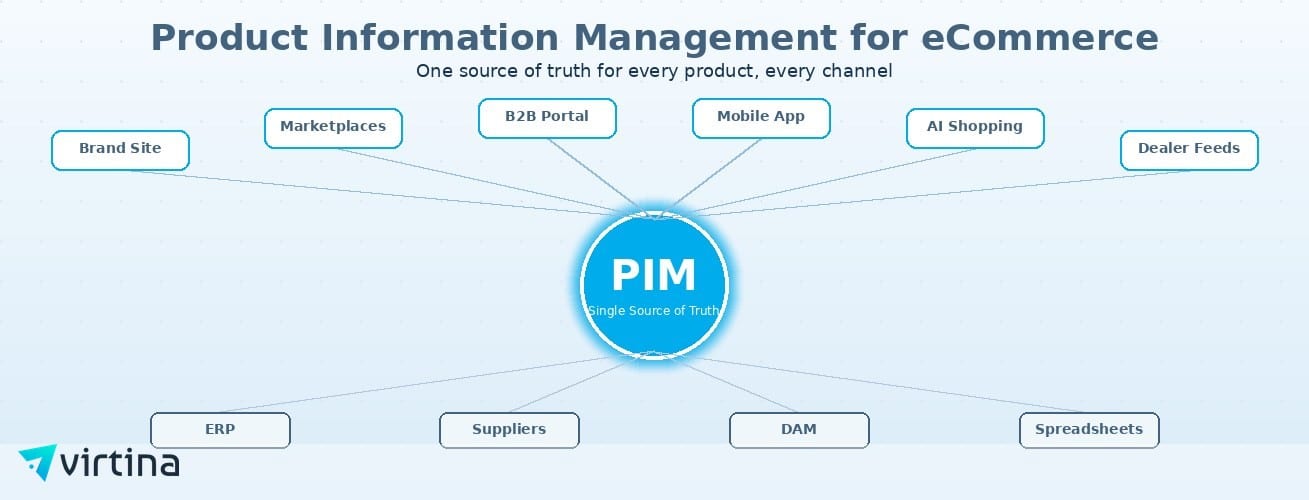
Your eCommerce site should be the "Single Source of Truth" for your entire operation. That means building a bridge between your CRM, ERP, and accounting software. If your team is still manually typing data from one screen to another, you haven't automated anything, you've just moved the paperwork to a digital desk.
Pillar 4: The MVP Strategy
It’s almost always better to launch a smaller, high-quality version of your site than a massive, glitchy one. Focus on five "perfect" features that work flawlessly. That’s significantly more profitable than launching twenty features that are broken, confusing, or just getting in the way.
Recovery Steps for Underperforming Launches
If a platform is live but underperforming, the priority is not to rebuild everything at once. The goal is to reduce friction quickly, protect revenue, and create a clear path to sustainable improvement.
What does post-launch recovery actually look like?
Step 1: Technical and UX Audit
Start by identifying the biggest points of friction affecting conversion and revenue. Review site speed, navigation, mobile usability, broken workflows, checkout issues, and any technical errors that create drop-off. Prioritize the three most damaging problems first so recovery efforts stay focused on the fixes with the highest business impact.
Step 2: Value Proposition Review
Once technical friction is assessed, evaluate whether the messaging is clear enough for customers to understand the offer immediately. If visitors cannot quickly see what the product is, who it is for, and why it matters, performance will continue to suffer. Recovery often depends as much on clarifying the message as on improving the platform itself.
Step 3: Checkout Optimization
The fastest gains often come from improving the bottom of the funnel. Review checkout flow, guest checkout availability, payment options, form length, error handling, and button placement. Even small improvements in this area can increase completed purchases and produce immediate revenue lift.
Step 4: External Technical Intervention
In some cases, internal teams are too close to the platform to diagnose problems objectively. An experienced external partner can bring a fresh perspective, specialized technical expertise, and a structured recovery plan. That outside view often helps businesses move faster from patching issues to building a healthier growth trajectory.
Conclusion
The future of eCommerce belongs to companies that treat a launch as the starting line for a high-performance asset, not just a box to tick on a calendar. As the digital market matures, the old "first-mover" advantage is losing ground to the "best-experience" advantage, where getting the technical details right matters more than just being fast. By investing in a real strategy now, you avoid the "hidden taxes" of technical debt and brand damage that eventually cripple rushed, unoptimized platforms.
Frequently Asked Questions
Use an MVP approach. Launch a high-quality, reduced-scope version of the project. This meets the deadline without compromising the code quality or the user experience.
Poor backend integration. A storefront is only effective if it syncs perfectly with inventory and shipping. Manual data entry prevents scaling.
Ideally, 15-20% of the total project budget. Spending this upfront prevents you from spending 50% on "repairs" and technical debt later.
In-house teams are often focused on maintenance. A specialized commerce partner brings experience from multiple industries and platforms, allowing you to avoid mistakes that others have already made.