TL;DR
- Two-week deadline. Shopify told ENDS merchants in late June 2026 to remove every vape product within about two weeks. The move followed a November 2025 letter from 25 state attorneys general, DC, Puerto Rico, and New York City.
- Not a vape-only story. The ban applies to all ENDS products regardless of FDA authorization status. It is not a vape-industry story: it proves any SaaS platform can drop a regulated category on short notice.
- WooCommerce removes the risk. WooCommerce removes this specific risk because you own the storefront outright. No company-wide product policy can suspend your store.
- Compliance still applies. Moving off Shopify does not remove PACT Act, age-verification, or payment-processor compliance requirements. It only removes platform-level deplatforming risk.
Introduction
Shopify told ENDS and vape merchants in late June 2026 to remove every vape product from their stores. The deadline was July 7-8, 2026, or the store risked suspension. That gave merchants roughly two weeks to react, far less time than a full replatform typically takes.
This reads like a vape-industry compliance story, but it isn’t. Shopify made a deliberate policy choice, under regulatory pressure, to drop an entire legal product category platform-wide. The same mechanism can hit CBD, firearms, kratom, or supplement merchants next.
Table of Contents
- What happened to vape stores on Shopify
- Why this is not just a vape industry problem
- Why any SaaS platform can deplatform you
- Why WooCommerce removes this platform risk
- Why payment gateways are a separate hurdle from platform choice
- How to migrate from Shopify to WooCommerce
- People also ask
- Conclusion
- Frequently asked questions
What happened to vape stores on Shopify
Shopify told ENDS merchants in late June 2026 to remove every vape product from their stores. They had about two weeks, or the store risked suspension. Individual notices went out around June 24, with a compliance deadline of July 7-8, 2026.
Reuters first reported the policy on June 23, 2026, before most merchants saw their own notice. The policy covers every ENDS product, including e-cigarettes, e-liquids, vaporizers, and parts, regardless of nicotine content or FDA authorization status. Shopify removed the category outright instead of reviewing products case by case.
The trigger was a November 2025 state attorneys general letter. A coalition of 25 states plus DC, Puerto Rico, and New York City sent it. A merchant with a clean compliance record got the same notice as one selling gray-market disposables.
Why did Shopify ban ENDS products
Shopify’s policy traces to the PACT Act, the Prevent All Cigarette Trafficking Act, extended to cover ENDS products in 2021. Sellers must meet PACT Act requirements, including ATF and state registration, monthly sales reporting, and adult-signature delivery. The FDA’s Premarket Tobacco Product Application process sits on top of that.
Only a small fraction of ENDS products nationally hold FDA marketing authorization. Shopify’s ban ignored authorization status entirely. That’s what turned a compliance sweep into a blanket, platform-wide removal.
What this means for you
If you sold ENDS products on Shopify, your store was at risk of suspension regardless of your compliance status. The policy was categorical, not case by case. FDA authorization didn’t exempt you, and Shopify published no manual appeal path.
- No published appeal path. Shopify gave merchants a deadline, not a review process.
- FDA authorization didn’t matter. Fully authorized products were removed along with everything else.
- Waiting past the deadline was risky. Continued listings put the whole store at risk, not just the flagged products.
Why this is not just a vape industry problem
Shopify’s ENDS ban proves any SaaS platform can drop a regulated category on short notice. That risk goes beyond vape merchants specifically. Read the coverage and it looks like a narrow vape-industry compliance story, but it isn’t.
The mechanism here is a platform-wide acceptable-use policy change made under external pressure. It doesn’t care what product sits inside the category. Any age-restricted or reputationally sensitive category a platform decides to drop faces the same exposure, compliant merchants included.
Which other high-risk categories face the same exposure
CBD, firearms, kratom, and supplement brands sit where vape merchants stood in June 2026. Each category already draws scrutiny from payment processors and state regulators. Retailers building firearm ecommerce solutions or a CBD ecommerce market storefront on a rented platform carry that same risk.
Why any SaaS platform can deplatform you
Any SaaS ecommerce platform can deplatform you because you don’t own the storefront. You’re operating inside its acceptable-use policy and terms of service, and both can change unilaterally. That’s true whether you’re comparing a WooCommerce vs Shopify comparison or evaluating SaaS ecommerce platforms generally.
What renting your storefront actually means
On a SaaS platform, your product catalog, customer data, and transaction history live inside the platform’s own systems, not yours. On a self-hosted store, that data lives in your own database, on infrastructure you control. One arrangement lets a third party suspend your business with a policy update, the other doesn’t.

Why WooCommerce removes this platform risk
WooCommerce removes this risk because self-hosted ecommerce puts you in control of the store. No single company’s product policy can suspend it. Self-hosted WordPress and WooCommerce put hosting, plugins, and payment gateway integration directly in your hands.
You can offer any legal product category your compliance program supports, without waiting on a platform’s approval. That control extends to payment gateway options too. Instead of choosing from a platform’s approved app list, you integrate the gateway that actually underwrites your category.
What WooCommerce gives you that Shopify doesn’t
- Full data ownership. Your product catalog, customer records, and order history live in your own database, not a vendor’s servers.
- No categorical product bans. No single company’s policy update can suspend your entire store.
- Payment gateway flexibility. You integrate any high-risk-compatible gateway instead of choosing from a platform’s approved list.
- No platform-wide terms of service exposure. You’re bound by your hosting provider and plugin licenses, both narrower than a full acceptable-use policy.
- Full code and workflow control. You build custom age-verification and compliance logic without waiting on app-store approval.
Most merchants making this move don’t do it alone. WooCommerce development services cover the build, the data migration, and the compliance logic in one project.
Why payment gateways are a separate hurdle from platform choice
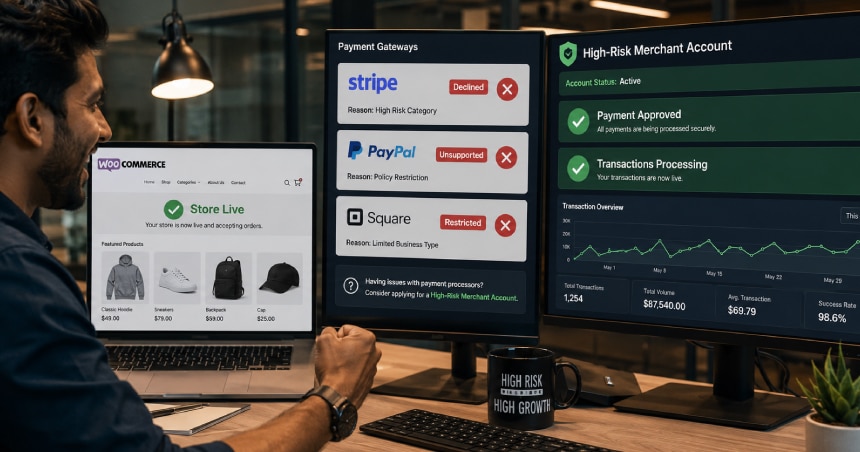
Moving to WooCommerce solves platform risk, but you still need a high-risk merchant account. Mainstream processors prohibit vape transactions outright, regardless of storefront platform. Stripe, PayPal, and Square all explicitly ban vape and ENDS transactions in their acceptable-use policies.
Processors classify ENDS merchants as high-risk because of elevated chargeback rates, age-verification liability, and reputational risk to the issuing bank. None of that changes once you migrate off Shopify.
How to find a payment gateway that accepts ENDS merchants
ENDS merchants typically need a high-risk payment gateway through a specialized acquiring bank, not a mainstream processor. Underwriting usually requires processing history, compliance documentation, and a reserve requirement. Payment gateway service providers that specialize in regulated categories can walk you through what an underwriter will ask for.
How to migrate from Shopify to WooCommerce without losing more time
Migrating from Shopify to WooCommerce means exporting your catalog and customer data first. Next, you stand up self-hosted WordPress with a compliant payment gateway. Then you test thoroughly before you point your domain at the new store.
A high-risk ecommerce migration runs in a different order than a standard replatform. The payment gateway has to be lined up before the store goes live, not after. A WooCommerce migration guide covers the mechanics of moving your catalog and customer data.
Your last migration may have followed a platform’s collapse, like the Volusion to WooCommerce migration wave. This one is different. Shopify isn’t collapsing: it made a policy choice, and the urgency comes from a deadline, not a dying platform.
Seven steps to migrate before your deadline hits
- Audit your catalog. Check every ENDS SKU against PACT Act and PMTA status before you build anything.
- Confirm PACT Act registration. Register with the ATF and every state you ship into, if you haven’t already.
- Apply for a high-risk merchant account early. Underwriting takes time, so start before you need the gateway live.
- Stand up self-hosted WordPress and WooCommerce. Configure an age-verification plugin built for your category.
- Migrate your catalog and customer data. Move products, accounts, and order history off Shopify in one pass.
- Test checkout, tax, and shipping end to end. Redirect old URLs before you point your domain at the new store.
- Go live and monitor closely. Watch chargebacks and compliance activity for the first 30 days.
People also ask
Does Shopify’s ban affect Shopify Plus merchants too?
Yes. The policy is platform-wide and applies across every Shopify tier. Public notices don’t include a Plus-specific exemption.
What happens if I miss the July deadline?
Shopify’s notices indicate that flagged products get removed, and continued listings put the store at risk of suspension. No grace period has been publicly documented.
Can I keep selling other products on Shopify while I migrate my vape catalog?
Yes. The ban targets ENDS products specifically, so non-ENDS product lines aren’t affected by the policy.
Conclusion
This is a platform-risk event, not a vape-industry footnote. Shopify didn’t fail: it made a policy choice under regulatory pressure. Any merchant selling in a regulated category should read that as a warning about where they’ve built their store.
If you’re racing a deadline, Virtina can help you move fast without breaking checkout. We won’t cost you SEO rankings or leave you with the wrong payment gateway. Contact Virtina’s team for emergency Shopify-to-WooCommerce migration support, and let’s ship a compliant, self-hosted store before your window closes.
Frequently asked questions
What happened to vape stores on Shopify?
Shopify told ENDS merchants in late June 2026 to remove all vape products by July 7-8, 2026, or risk suspension. It followed a November 2025 letter from state attorneys general flagging illegal ENDS sales on the platform. It applies to every ENDS product, including FDA-authorized ones.
Can I sell vape products on WooCommerce?
Yes. WooCommerce has no product-category policy blocking ENDS sales. You still need PACT Act registration, age verification, and a payment gateway willing to underwrite high-risk ENDS transactions.
How do I migrate my vape store from Shopify?
Export your product catalog, customer data, and order history, then set up self-hosted WooCommerce with a high-risk-compatible payment gateway. Redirect old URLs and test checkout thoroughly before you point your domain at the new store.
What payment gateways accept vape merchants?
Mainstream processors like Stripe, PayPal, and Square explicitly prohibit vape and ENDS transactions. ENDS merchants need a high-risk merchant account through a gateway or acquiring bank that underwrites regulated categories.
Is it legal to sell vape products online?
Yes, but only FDA-authorized ENDS products, sold under PACT Act registration, age verification, and adult-signature delivery requirements. Many states and cities add their own flavor or sales restrictions on top of federal rules.
What is an ENDS product?
ENDS stands for Electronic Nicotine Delivery Systems, the federal term for e-cigarettes, vaporizers, e-liquids, and related parts and refills. Both the PACT Act and the FDA regulate ENDS products regardless of nicotine content.
Why did Shopify ban vape stores?
Shopify acted after a coalition of attorneys general sent a letter in November 2025. The 25-state coalition, plus DC, Puerto Rico, and New York City, flagged illegal ENDS sales on Shopify-hosted stores. Shopify’s June 2026 policy removed ENDS platform-wide instead of reviewing merchants case by case.
How long does a Shopify to WooCommerce migration take?
A standard migration typically takes several weeks to a couple of months, depending on catalog size and integrations. Merchants racing a compliance deadline can move faster. Rushed timelines still need real testing to avoid breaking checkout or losing SEO rankings.
Does moving to WooCommerce remove all compliance requirements?
No. PACT Act registration, age verification, adult-signature delivery, and state-level rules apply no matter which platform you use. Moving to WooCommerce removes platform-level deplatforming risk, not your regulatory obligations.
Virtina Team. Virtina is an eCommerce solutions partner that strategizes, optimizes, and solves for B2B and B2C brands facing platform risk, migrations, and performance issues across WooCommerce, Magento, Shopify, and BigCommerce.