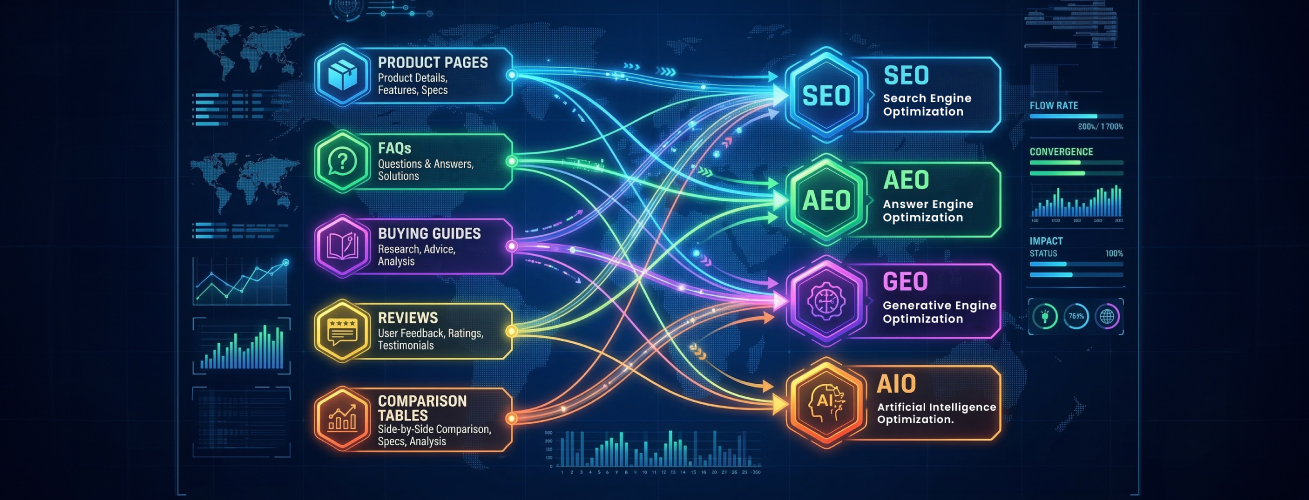
Summary
Your website contains all the information a customer needs to buy from you. However, modern B2B buyers now use AI tools, procurement bots, and search algorithms to shortlist suppliers before a human ever visits your site. If these machines cannot "read" your data, a technical failure known as a Schema Gap, your company is automatically filtered out of the deal. You aren't losing the sale to a better competitor; you are losing it to a machine that doesn't know you exist.
Introduction
In the physical world, your sales reps navigate the gatekeepers. In the digital world, your data must navigate the Digital Gauntlet. Before a procurement officer ever sees your brand, a sequence of automated filters evaluates your company’s airworthiness.
If a machine cannot verify your technical specs or trust your availability at Step 1, you are "ghosted" at Step 2. You don't just lose the rank; you lose the right to be considered.
Table of Contents
Who This Blog Is For
This article is written for decision makers, not implementers.
Specifically:
If you approve budgets, set priorities, or evaluate performance at the business level, this is for you.
What is "Schema"
Schema is not a marketing tactic. It is a digital labeling system. Imagine a warehouse where 10,000 crates have no labels. A human can open a crate and see it’s a "Grade 316 Stainless Valve," but an automated forklift (the AI) will ignore it because it can’t read the contents.
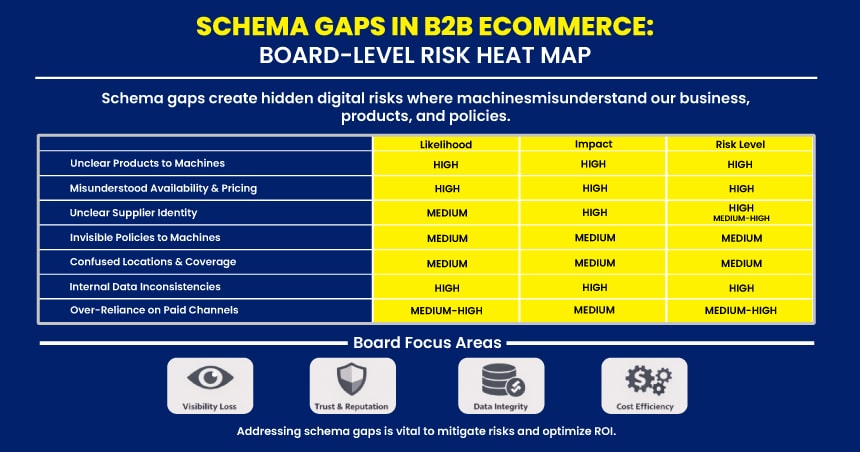
The Four Strategic Risks of "Invisible" Data
I. Visibility Risk (The Search Gap)
When an engineer searches for a specific technical SKU or model number, and your data isn't machine-readable, your competitor’s product appears instead—even if your product is superior. You spend millions on R&D for products that machines cannot find.
II. Trust Risk (The Credibility Gap)
Procurement bots are programmed to avoid risk. If a machine cannot verify your warranty, physical locations, or certifications, it flags your company as "unreliable." You are excluded from "Approved Vendor" lists before the RFP even begins.
III. Capital Efficiency Risk (The Ad Spend Trap)
When your site is "unreadable," your organic visibility drops. Companies often try to "fix" this by throwing more money at Paid Ads (PPC). You are paying a "tax" to buy back the traffic you should have owned for free through data clarity.
IV. Operational Risk (The Data Conflict)
If your ERP, your website, and your sales team are all saying different things about inventory or pricing, the machine defaults to the "safest" (often lowest) visibility. Manual workarounds, customer friction, and lost orders.
People Also Ask
Is schema only relevant for SEO?
No. Schema affects how many automated systems interpret and trust your business, not just search engines.
Does schema matter if we sell through sales reps?
Yes. Buyers research suppliers before contacting sales, and machines shape that research.
Is this only for large enterprises?
No. Mid-market companies often feel the impact faster because they lack margin for inefficiency.
Does schema require exposing sensitive pricing?
No. Schema should reflect what is publicly visible. For RFQ models, availability and intent signals matter more than price.
Why Schema Gap Hits B2B Hardest

Complexity is the enemy of machines. In retail, an algorithm only needs to identify "a shoe." In industrial distribution, an algorithm must identify a "3/4 inch NSF-certified Grade 316 Stainless Ball Valve."
When your technical specifications are buried in PDFs or unformatted text, the machine’s "error rate" skyrockets. This is the Complexity Penalty. By not providing Schema, you force AI to guess your capabilities. If the AI is only 70% sure about your spec but 90% sure about a competitor's, it will recommend the competitor every time to avoid risk. Solving this doesn't require a new website; it requires harvesting the data already locked in your ERP and PIM.
The B2B Complexity | The Result of a Schema Gap |
|---|---|
Technical SKUs | Machines fail to link the part number to the search intent. |
Tiered Pricing | Machines can't tell if a product is "buyable" or "request for quote." |
Logistics/Area | Machines don't know your shipping zones, so you're excluded from regional searches. |
How to Bridge the Schema Gap
Solving a Schema Gap doesn't require a new website; it requires harvesting the data already locked in your systems.
The Data Audit
Identify where your "labels" are missing. Compare your website code against B2B Structured Data Standards to find your Schema Coverage Score.
Automated Extraction
Do not have marketers manually type data into the website. The solution is to create a direct pipeline between your Product Information Management (PIM) or ERP and your website’s code. When a lead time changes in the ERP, the machine-readable "label" updates automatically.
Deploying Machine-Readable Truth
To make your data truly machine-readable, your site needs to output JSON-LD, which essentially acts as a standardized, digital spec sheet that sits behind the scenes of your web design. Think of it as translating your catalog into a language that AI and procurement bots can digest without error.
Pillar | Technical Requirement (JSON-LD) | The "Machine" Logic | Strategic Business Outcome |
|---|---|---|---|
Technical Specs | Material, dimensions, voltage, additionalProperty | Moves beyond "vague text" to define specific engineering attributes. | Ensures you appear in highly specific searches |
Logistics | OfferShippingDetails, MerchantReturnPolicy | Hard-codes transit speeds, shipping zones, and return windows. | Eliminates the "risk penalty" bots apply to suppliers with hidden or unknown terms. |
Identity | Organization | Links your site to verified DUNS numbers and ISO certifications. | Creates a digital paper trail that proves you are a high-trust entity, not an unverified reseller. |
The 5 Pillars of Machine-Readable Truth
Pillar | Boardroom Question | Technical Requirement (JSON-LD) | Strategic Business Outcome |
|---|---|---|---|
Product Clarity | Does the machine match us to the buyer's exact spec? | Every material, dimension, and power rating is tagged as distinct data fields. | Precision Visibility: Ensures your products appear in highly specific technical searches (e.g., "3/4 inch NSF-certified valve"). |
Availability | Is the machine telling buyers we are "ready to ship"? | Live signals for "In Stock," "Lead Time," or "RFQ" status integrated into the page code. | Shortlist Retention: Prevents procurement bots from automatically filtering you out due to "Unknown" availability. |
Identity | Does the algorithm trust that we are a real entity? | Organization Schema linking the site to physical HQ, manufacturing sites, and DUNS numbers. | Verified Authority: Distinguishes your brand from unverified third-party resellers or "ghost" distributors. |
Coverage | Do we appear in the buyer's specific region? | Geographic "AreaServed" definitions and local distribution hub geocoding. | Logistics Optimization: Captures 100% of regional demand while eliminating irrelevant leads from outside your shipping zones. |
Protection | Does the machine see us as a low-risk partner? | Standardized fields for MerchantReturnPolicy and warranty (removing data from PDFs). | Compliance Approval: Passes automated risk-assessment filters used by enterprise procurement soft |
Cross-Functional Ownership of the Schema Gap
A common failure in manufacturing organizations is treating Schema as a "one-time SEO project" owned by a junior marketer. At the Board level, this must be viewed as a Cross-Functional Data Asset.
The Triad of Ownership:
The CIO (Data Source)
Responsible for the "Single Source of Truth." Ensuring that the ERP and PIM data is clean and exportable.
The COO (Operational Truth)
Responsible for ensuring that availability signals and return policies in the schema match real-world warehouse capabilities.
The CMO (Market Access)
Responsible for the "last mile,"ensuring the technical JSON-LD tags are correctly deployed on the site to capture demand
Conclusion
In modern B2B commerce, Visibility is precision, and Trust is accuracy. Schema gaps are a signal of how clearly your business is understood by the systems that control buyer access. Closing these gaps is about reducing hidden risk, improving capital efficiency, and protecting long-term competitiveness. Machines are already judging your business. The only question is whether they understand it correctly.
FAQs: Agentic AI and the Future of Online Retail
Silent exclusion from buyer consideration and rising cost to compensate.
Often in weeks, not months, because the data already exists.
Typically a shared responsibility between IT, ecommerce, and operations, with executive sponsorship.
No. Schema clarity should evolve as products, catalogs, and policies change.