Summary
Search is entering a new phase shaped by generative artificial intelligence. Instead of showing only ranked lists of webpages, search platforms increasingly generate summaries, product recommendations, and direct answers inside the search interface.
Google’s AI Overviews and conversational search tools are central to this shift. AI-generated summaries now appear in a significant portion of searches and can reduce clicks to traditional results in some scenarios.
For eCommerce brands, visibility depends not only on ranking in search results but also on whether content can be understood, summarized, and referenced by AI systems.
Approaches such as AI Optimization (AIO), Answer Engine Optimization (AEO), and Generative Engine Optimization (GEO) are emerging as new concepts to help brands adapt to AI-driven search. Brands exploring these strategies can learn more about SEO to AIO and GEO strategies for eCommerce growth.Introduction
Search engines have long been the foundation of eCommerce discovery. For years, brands relied on traditional SEO strategies such as keyword optimization, backlinks, and technical performance to rank higher in search results.
This model is now evolving.
Generative artificial intelligence is changing how users interact with search platforms. Instead of typing short keywords and browsing multiple results, users increasingly ask complex questions and receive summarized answers.
For example, a user may search for:
AI-powered search systems analyze these queries and generate responses that synthesize information from multiple sources. Because these responses often provide immediate explanations and product suggestions, users may visit fewer websites before making decisions.
For eCommerce companies, this transformation introduces both challenges and opportunities. While AI summaries may reduce some traditional search clicks, they also create new ways for brands to appear in search results.
To succeed in this environment, marketers are expanding their strategies beyond traditional SEO. Concepts such as AIO, AEO, and GEO represent emerging approaches designed to help content perform well in AI-driven search experiences.
Table of Contents
The New SEO Concepts for AI Search
As search evolves, eCommerce SEO must adapt to how AI systems interpret and present information. Three concepts are commonly discussed in AI search optimization.
Comparison of AIO, AEO, and GEO
Concepts | Meaning | Core Goal |
|---|---|---|
AIO (AI Optimization) | Structuring content so AI models can interpret it clearly. | Make content understandable to AI systems. |
AEO (Answer Engine Optimization) | Optimizing content so search engines can provide direct answers (e.g., Snippets). | Become the primary source of the answer. |
GEO (Generative Engine Optimization) | Increasing the likelihood of being cited in LLM/Generative AI responses. | Become a referenced, authoritative source. |
These approaches do not replace traditional SEO. Instead, they expand it. For eCommerce companies, success in AI search often requires combining:
Together, these strategies help AI systems understand and reference your content.
The Evolution of Search: From Keywords to AI Answers
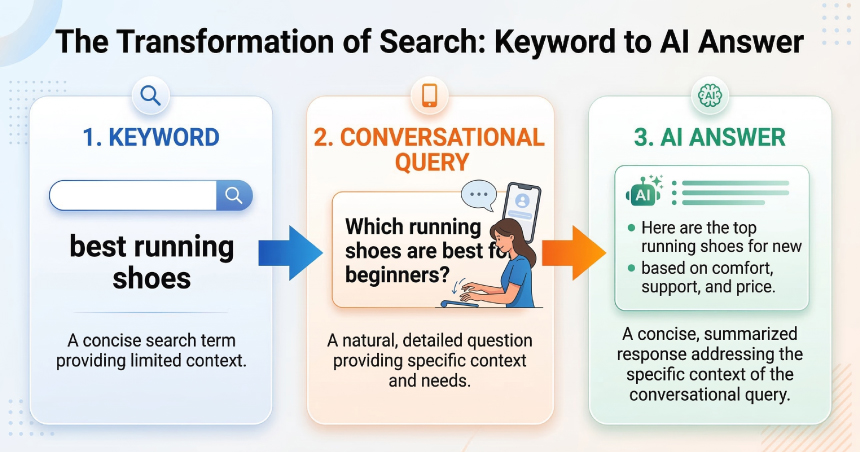
For decades, search engines worked using a straightforward model. A user entered a keyword. The search engine retrieved relevant webpages. Algorithms then ranked those pages according to relevance and authority.
Traditional SEO grew around this model. Brands optimized their websites for keywords such as:
Ranking higher for these terms often translated into higher traffic and sales.
However, user behavior has gradually changed.Instead of searching with short phrases, users now ask detailed questions that reflect their intent.
Examples include:
AI search systems are designed to interpret these complex queries.
Instead of presenting only a list of links, AI-powered search tools may provide:
Because these responses consolidate information from multiple sources, the number of pages users need to visit during research may decrease. For eCommerce brands, this means the competition is no longer limited to ranking in search results. The goal increasingly includes being included in AI-generated answers.
The Rise of AI Search and Zero-Click Behavior
One important development in modern search is the increase in zero-click searches.
A zero-click search occurs when users receive the information they need directly on the search results page without clicking a link.
Several studies suggest this behavior has become common in recent years.
In many cases, users obtain information through:
AI search experiences amplify this trend because they often deliver full explanations within the search interface.
For example, a user asking “What size TV should I buy for a small living room?” might receive an AI-generated summary explaining recommended screen sizes based on viewing distance.
If the answer already contains the information users need, they may not feel the need to click through to external websites.
However, when brands appear inside those AI-generated responses, they gain strong visibility.
This creates a new competitive environment in which content must be structured so AI systems can interpret and reference it.
Understanding AIO: AI Optimization

AI Optimization focuses on making content understandable to artificial intelligence systems.
Large language models interpret information by analyzing patterns in language and relationships between concepts.
Content optimized for AI typically includes several characteristics:
For eCommerce websites, AIO often involves improving product descriptions and educational content.
Consider the following example.
Basic description
“Premium ergonomic office chair.”
AI-optimized description
“This ergonomic office chair includes adjustable lumbar support designed to reduce lower-back strain during long work sessions.”
The improved description provides more context about:
This additional information helps AI systems understand how the product relates to common search queries.
also encourages content formats that are easy to interpret, such as:These formats improve readability for both users and AI systems.
Understanding AEO: Answer Engine Optimization

Answer Engine Optimization focuses on helping search engines deliver direct answers.
Answer engines include:
Instead of presenting a list of webpages, these systems extract specific information from content and display it as an answer.
For eCommerce websites, AEO often means structuring content around buyer questions.
Common eCommerce queries include:
Content that provides clear answers to these questions may be selected by answer engines.
Effective AEO content often includes:
FAQ sections are particularly useful because they provide direct answers in a format that search engines can easily interpret.
Understanding GEO: Generative Engine Optimization
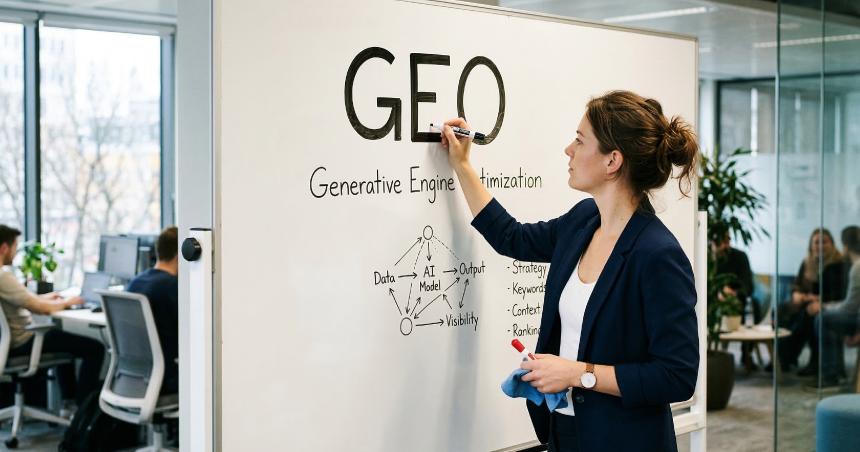
Generative Engine Optimization focuses on improving the likelihood that content will be referenced in AI-generated responses.
Generative search tools such as conversational assistants synthesize information from multiple sources to create answers.
These systems may cite or reference websites when summarizing topics.
GEO strategies aim to increase the probability that a website becomes one of those sources.
Content that demonstrates expertise and provides structured explanations may be more likely to be referenced.
Examples of GEO-friendly content include:
For eCommerce brands, GEO can help products appear in AI-generated buying recommendations.
Why AI Search Matters for eCommerce
Search has always been one of the most important traffic sources for eCommerce.
However, AI search is changing how users evaluate products.
Traditional product discovery typically followed this process:
AI-driven discovery may look different.
Because AI summaries consolidate information, fewer websites may receive traffic during the research process.
This makes visibility inside AI responses increasingly valuable.
AEO Strategies for eCommerce Websites
Answer Engine Optimization is one of the most practical strategies for eCommerce companies.
Many buyer questions follow predictable patterns.
Examples include:
Creating structured content that answers these questions can improve visibility in answer engines.
1. Create question-based content
Instead of focusing only on keywords, build content around real customer questions.
Examples:
This type of content aligns with conversational search behavior.
2. Add structured FAQ sections
FAQ sections provide concise answers that search engines can extract easily.
Example:
Question: How long does a laptop battery last?
Answer: Most modern laptops provide between 6 and 12 hours of battery life depending on the model and usage.
3. Use schema markup
Structured data helps search engines interpret product details such as:
Schema markup can support both traditional SEO and AI search visibility.
GEO Strategies for eCommerce Visibility
Generative Engine Optimization focuses on building authority and publishing content that AI systems may reference.
Publish comprehensive buying guides
Buying guides help AI systems understand product categories.
Examples include:
These guides often answer multiple questions within a single article.
Create product comparison pages
Comparison pages help users evaluate options and provide structured information for AI systems.
Feature | Product A | Product B |
|---|---|---|
Price | $899 | $999 |
Battery Life | $10 hours | $12 hours |
Weight | 1.5 kg | 1.3 kg |
Tables like this make it easier for AI systems to interpret product differences.
Build topical authority
AI systems appear to favor sources that consistently publish high-quality content within a niche.
A website that regularly produces educational content about a product category may be interpreted as more reliable.
Examples of authority-building content include:
AIO Strategies for AI-Readable Content
AI Optimization focuses on making content easier for AI systems to understand.
Use clear language
Avoid vague marketing language.
Instead of:
“A revolutionary gaming headset.”
Use:
“This gaming headset includes surround sound and a noise-canceling microphone designed for multiplayer communication.”
Provide context
Explain:
Example:
“This lightweight travel backpack may suit frequent travelers because it fits under airplane seats and includes multiple compartments.”
Structure content clearly
Helpful formats include:
Structured content improves readability and interpretability.
AI Search Content Strategy for eCommerce
A comprehensive AI search strategy combines multiple optimization layers.
Content Strategy Hierarchy: SEO to AIO
Strategy Layer | Focus | Example Content |
|---|---|---|
SEO | Ranking in search results (Blue links) | Category pages, Blog archives |
AEO | Providing direct answers (Snippets) | FAQ content, How-to guides |
GEO | Being cited in AI responses (Citations) | Buying guides, Expert reviews |
AIO | AI-readable structure (Model training/RAG) | Product explanations, Technical docs |
Together, these layers create a more resilient search strategy.
Measuring AI Search Visibility
Tracking AI search performance is still evolving.
However, eCommerce brands can monitor indicators such as:
Some SEO platforms are beginning to develop tools designed to track brand citations inside generative search responses.
The Future of eCommerce Search
AI search technology continues to develop rapidly.
Several trends appear likely:
As AI search adoption increases, eCommerce brands may compete not only for rankings, but also for visibility within AI generated responses. For brands working with experienced eCommerce partners such as Virtina, this shift creates new opportunities to improve discoverability, strengthen content strategy, and stay competitive in AI-driven search environments.
Frequently Asked Questions
Generative Engine Optimization aims to increase the likelihood that content will be referenced in AI-generated responses from conversational search systems.
Current evidence suggests AI search is changing how SEO works rather than replacing it. Traditional signals such as authority and relevance still influence which sources AI systems reference.
Key steps include:
- publishing detailed buying guides
- creating structured FAQs
- building topical authority
- writing clear product explanations
- maintaining strong SEO fundamentals.
AI-generated answers deliver information directly within search interfaces, allowing users to obtain explanations without visiting external websites.