Summary
Magento is still one of the most capable eCommerce platforms in 2026, especially for catalog-heavy, B2B, and multi-store businesses. This guide explains what Magento is today (Magento Open Source and Adobe Commerce), its main benefits and exclusive features, how to plan a Magento development project, the challenges to expect, and why staying on a supported version matters.
Introduction
Magento remains one of the strongest platforms for serious eCommerce in 2026. Now backed by Adobe as Adobe Commerce, with the free Magento Open Source edition alongside it, the platform combines powerful features and a deep extension ecosystem to run complex catalogs, B2B buying, multi-store setups, and high order volumes. Flexibility, scalability, security, and payment options are why growing and enterprise brands still choose it.
In 2026 the question is no longer only whether Magento can do the job. It is which version, hosting setup, and storefront approach will keep your store fast, secure, and supported. Releases such as 2.4.8 and 2.4.9, modern PHP, OpenSearch, and headless or Hyvä-based storefronts all shape what a successful Magento development project looks like today.

Table of Contents
- Summary
- Introduction
- What is the Magento Platform?
- Compatible With All Business Types
- What Are the Benefits of Magento?
- Magento Compatibility
- Exclusive Features on Magento
- Migration to Magento
- Requirements on a Magento eCommerce Development Project
- Challenges on a Magento Store
- Why Choose Virtina for Magento eCommerce Development?
- Conclusion
- Frequently Asked Questions (FAQ)
What is the Magento Platform?
Adobe Inc. owns Magento, an open-source eCommerce platform first released in 2008. Today the family includes Magento Open Source, the free self-hosted edition, and Adobe Commerce, the paid edition formerly known as Magento Commerce or Enterprise Edition. Adobe Commerce is available self-managed, on Adobe’s cloud infrastructure, and as a cloud service.
The platform is written in PHP and uses MySQL or MariaDB for databases, with OpenSearch handling catalog search. Its modular architecture lets developers tailor the platform to specific business requirements. Current 2.4.x releases support modern PHP versions (2.4.8, for example, supports PHP 8.3 and 8.4), so keeping your stack current is part of owning a Magento store. It serves local retailers, large fashion labels, manufacturers, and B2B firms alike.
Compatible With All Business Types
Whether large or small, eCommerce businesses care about flexibility, scalability, and security. Magento covers all three, and both Magento Open Source and Adobe Commerce are built to adapt to different business models rather than force one on you.
Magento Open Source is free to download and a common choice for small and mid-sized businesses that have development support. You customize and self-host it, and it delivers the core commerce features. Adobe Commerce adds advanced B2B tools, content staging, customer segmentation, and Adobe support, which suits larger enterprises with big catalogs and many users.
Buyers in 2026 expect fast pages, accurate search, and personalized experiences. Magento’s open architecture lets you meet those expectations through performance tuning, modern storefronts, and integrations, while you keep ownership of your code and data.
Retailers, manufacturers, distributors, and startups rely on Magento, across B2B and B2C and across industries. It is one of the few platforms that adjusts to nearly any business model without a rebuild.

Adobe Commerce (formerly Magento Commerce) is ideal for companies selling in the B2B sector. It includes company accounts, requisition lists, quick order, and quote negotiation that simplify ordering and bulk purchasing. Wholesale buyers can reorder products and automate recurring purchases.
Each company account can have multiple users with different roles and permissions. Sellers can set shared catalogs, custom pricing, and payment and shipping rules per company, and run targeted marketing campaigns. Magento also supports a streamlined checkout, so repeat buyers can order quickly.
What Are the Benefits of Magento?
Magento includes a robust shopping cart and checkout that connects to many payment options, including cards, wallets, and buy now pay later providers, so customers face little friction at checkout. Businesses can start small and expand as demand grows, which sets Magento apart from many other eCommerce platforms.
Because Magento’s source code can be accessed and modified, developers can customize the platform to specific company requirements. That freedom supports unique buying experiences that stand out in a crowded market. Magento also handles large catalogs, promotions, and sales events well, which benefits both B2C and B2B organizations.
SEO Features
Magento includes several features that support SEO. Owners can generate an XML sitemap and submit it to search engines, and the URL Rewrite tool lets them manage URLs for products, categories, and CMS pages with proper redirects.
Owners can edit meta titles, descriptions, canonical tags, and robots directives for each page. Product pages ship with structured data, and extensions or custom development can extend schema for reviews, FAQs, and breadcrumbs. Clean URLs, fast pages, and structured data also help your catalog get discovered in AI search and answer engines.
Flexibility
Magento gives owners control over every aspect of the store, including look, content, and functionality. This makes it possible to build a distinctive storefront and shopping flow rather than adapting your brand to a template.
Teams can work on the front end or back end independently, including headless setups where Magento handles commerce through GraphQL and REST APIs while a separate front end delivers the experience. Hyvä-based themes are also popular for faster, lighter storefronts. Either way, the store is yours to shape.
Modular
Modularity is the core architectural principle of Magento. A module extends a specific piece of functionality and keeps its dependencies on other modules to a minimum, so adding or removing a module does not disrupt the rest of the store.
Each module is made of PHP and XML files that address a specific business feature. Because modules are self-contained, you can configure, replace, or disable one without touching the core code, which keeps upgrades far safer when customizations are built the right way.
Support
Support depends on your edition. Adobe Commerce customers get access to Adobe’s support team and can submit tickets, report bugs, and request features. Magento Open Source relies on the community, official documentation, and your development partner.
For Magento Open Source stores, a reliable agency partner for support and maintenance matters even more. Regular security patches, quarterly releases, and extension updates all need a team that applies them on schedule.
Performance
Adobe Commerce provides enterprise-grade performance, and Magento stores of every size can be tuned for speed. Owners can use a content delivery network (CDN) and Varnish for full-page caching, with custom rules where needed.
Front-end optimization, such as minifying JavaScript, CSS, and HTML, compressing images, and serving modern formats from locations near the visitor, also helps. Good hosting, Redis caching, and archiving old orders improve store performance, and these directly support Core Web Vitals and conversion rate.

Scalability
If we are talking about performance, scalability is never far behind. Magento can handle large catalogs and heavy traffic when it is hosted and configured properly, which makes it a strong fit for stores with many SKUs and traffic spikes.
Owners can also run several stores, brands, and languages from a single backend. All data is managed centrally, and the architecture scales from a single store to a multi-store, multi-currency operation.
Security
Security is a major strength when you stay current. Adobe Commerce on Adobe’s cloud infrastructure is PCI DSS compliant, and Adobe publishes regular security patches for supported versions. Magento also includes protections against cross-site scripting, clickjacking (through the X-Frame-Options header), and other common attack types.
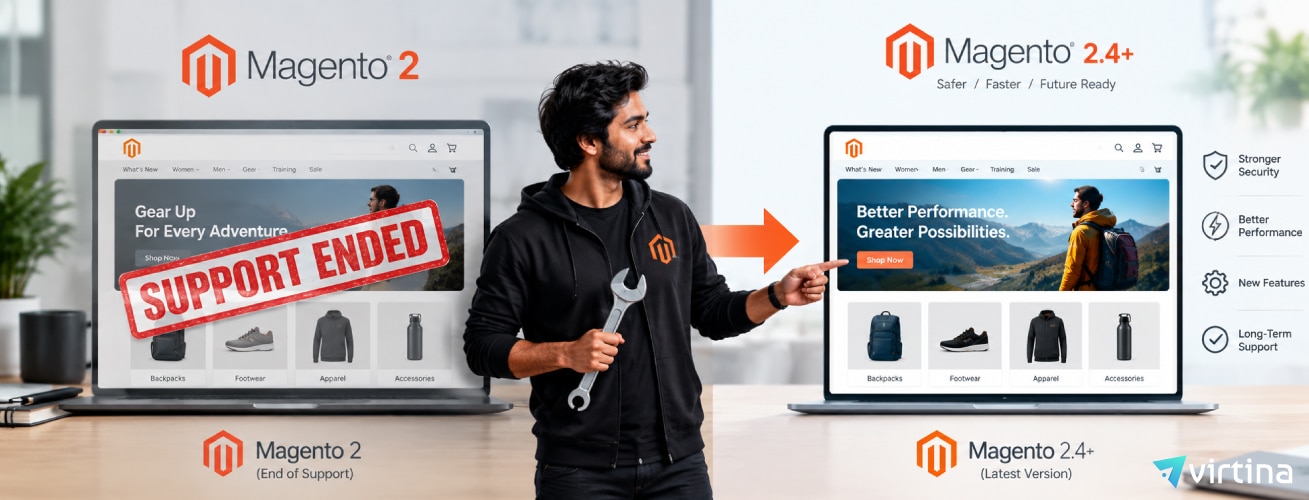
Admin logins use two-factor authentication by default. Staying on a supported version is critical, because Adobe states that unsupported versions no longer receive security fixes.
Checkout is protected with SSL, and tokenized payment integrations keep card data away from your servers. Combine these with regular patching, a web application firewall, and monitoring for a strong security posture.
Mobile-friendliness
Mobile commerce now makes up a large share of online revenue, so the mobile experience matters. Magento supports responsive design, and its themes adapt menus, images, and checkout to desktops, tablets, and phones.
Modern options such as Hyvä and headless storefronts deliver fast, touch-friendly experiences with strong Core Web Vitals scores. They can be customized so content and checkout align well on every screen size.
For app-like speed, many teams now choose headless or progressive web app approaches built on Magento’s GraphQL APIs, including Adobe’s newer storefront options. Adobe’s older PWA Studio is no longer the primary path for new builds, so confirm the right approach with your Magento development partner.
Analytics
Magento gathers extensive business insights through built-in reporting on sales, products, customers, and traffic. Key metrics help you track business performance and customer behavior.

Connect Google Analytics 4, Adobe Analytics, Adobe Commerce Intelligence, or other tools to turn that data into actionable insights. Server-side tracking and consent-aware analytics are increasingly important for accurate measurement in 2026, and Magento supports them through extensions and custom integrations.
Integrations
There is virtually no limit to what you can integrate with Magento. It supports payment gateways, shipping carriers, marketplaces, and database apps through extensions and APIs, so owners can add the features they need.
Magento integrates with CRM, inventory, accounting, POS, ERP, PIM, and other business software through REST and GraphQL APIs. Streamlining operations improves internal processes and the buyer experience.
The right integration can give your business the push it needs, and increasingly that includes AI-driven search, recommendations, and customer service tools. Integrate your store with any third-party app that gives you an edge.
Magento Compatibility
Compatibility is where Magento development gets practical. Your version, PHP, database, search engine, extensions, and theme all have to work together.
Current Magento 2.4.x releases rely on OpenSearch for catalog search, and each release supports a defined range of PHP versions. Check Adobe’s system requirements before you upgrade, because older extensions and themes may not support newer PHP or library versions.
Magento Open Source and Adobe Commerce share the same core, so most extensions work on both, although some need edition-specific code. Always confirm that every extension, custom module, and integration is tested on your target version before going live.
If you are on an older release, a compatibility audit shows what will break and what it costs to fix. Our Magento upgrade services cover the audit, the upgrade itself, and testing, so your store stays supported and secure.
Exclusive Features on Magento
Search Wizard
Magento has stronger search than many eCommerce platforms. Since Magento 2.4, a dedicated search engine is mandatory, and OpenSearch is now the supported engine for current releases. Magento supports quick search for full or partial product names, advanced search with several parameters, and weighted search, where attributes with a higher weight appear higher in results. Store owners can also review popular search terms and search the orders grid by keyword. For better relevance, many stores add AI-powered search and recommendation tools.

Order Management
Order management helps you handle orders, invoices, shipments, and credit memos. From the orders workspace, the admin can view and control order histories and see current and past orders.
Admins can sort, filter, and search orders, apply actions in bulk, and export order data for finance and fulfillment teams. Owners can create new orders from the admin, and integrations with ERP and shipping tools keep fulfillment accurate.
Return Management
Adobe Commerce users can manage returns from a dashboard in the backend. Owners can assign a Return Merchandise Authorization (RMA) to customers who request a replacement or refund, which keeps return data organized.
The RMA number identifies the returned product. The Returns grid lists all pending requests, and admins can create new return requests. RMAs can be issued for simple, grouped, and bundle products, but not for virtual products, downloadable products, and gift cards.
Email Reminders
In Adobe Commerce you can send email reminders to customers who meet preset conditions, for example when a customer abandons a cart or adds an item to a wishlist.
Reminders encourage customers to return to the store and can include a coupon code as an incentive. Admins can send emails a few days after a cart is abandoned and set conditions such as cart value, quantity, and items in the cart. Many merchants now pair this with email platforms such as Klaviyo or Brevo for richer automation.
Customer Segmentation
Magento lets store owners segment customers by address, order history, shopping cart contents, and more. Owners can then display content and promotions to specific groups.
Owners can target campaigns by segment, set special shopping cart price rules, generate detailed reports, and export lists of targeted customers.
Segmentation creates more personalized conversations with each buyer. With first-party data growing in importance, it helps improve promotions, profit, and customer satisfaction.
Rewards and Loyalty
In Adobe Commerce, owners can run a reward points program to drive engagement and loyalty. Points can be awarded for purchases or other activities, and the system controls allotment, balances, and expiration. Customers redeem points at checkout.
Points can be awarded under shopping cart rules the admin sets, and admins can adjust balances. Customers can view their points balance, and orders paid with points can be refunded to store credit once an admin approves. Many stores also add dedicated loyalty extensions.
Admin
Unlike many platforms, Magento allows several admins to work on the site at the same time, with role-based permissions. Admins can use a custom Admin URL instead of the obvious defaults.
For security, two-factor authentication is enabled by default. Admins can configure password rules, session lifetime, and the number of login attempts before an account is locked.
They can also set how long a session stays active during inactivity and require a CAPTCHA at login for extra protection.
Content Management
Magento store owners can create and manage quality content, which differentiates their site, supports search visibility, and educates customers. Owners can promote products and the business with valuable information.
Owners can build pages with text, images, blocks, and widgets using Page Builder, and create reusable templates without writing code. Blocks can be placed in any part of the layout. Content staging in Adobe Commerce lets admins create, preview, and schedule content updates, and prepare versions for future campaigns.
Migration to Magento
If you are thinking of migrating your online store, Magento is a strong destination, especially for catalog-heavy and B2B businesses. Current 2.4.x releases give you modern PHP support, OpenSearch, GraphQL APIs, and a large marketplace of themes and extensions.

A good migration plans for data (products, customers, and orders), URLs and redirects that protect SEO, extensions, and integrations. Magento’s documentation, data migration tools, and community help, and an experienced partner reduces the risk of lost rankings and downtime.
Requirements on a Magento eCommerce Development Project
An open source Magento development project needs hosting that suits your traffic, because hosting affects page speed and store success. You also need to choose a theme: a pre-built theme, including Hyvä-based options, or a custom theme. Before that, document the features your eCommerce site needs.
Check the payment solutions that support your transactions, and list the shipping providers that handle logistics, show carrier rates at checkout, and generate labels. Plan your budget and timeline, and decide which Magento version and edition fit your needs before you build.
List the ERP, CRM, inventory software, and other integrations you will use. Check all the extensions you need and what must be custom coded. Address content management, SEO, and accessibility requirements, and audit your business processes. Don’t overlook the quality of the Magento web development team you choose.
Challenges on a Magento Store
Magento Open Source can be tricky for first-time users. It does not include Adobe-managed PCI compliance, and security patches must be applied by your own team or partner. Third-party extensions can introduce bugs, conflicts, and upgrade problems, and some extension developers offer little support.
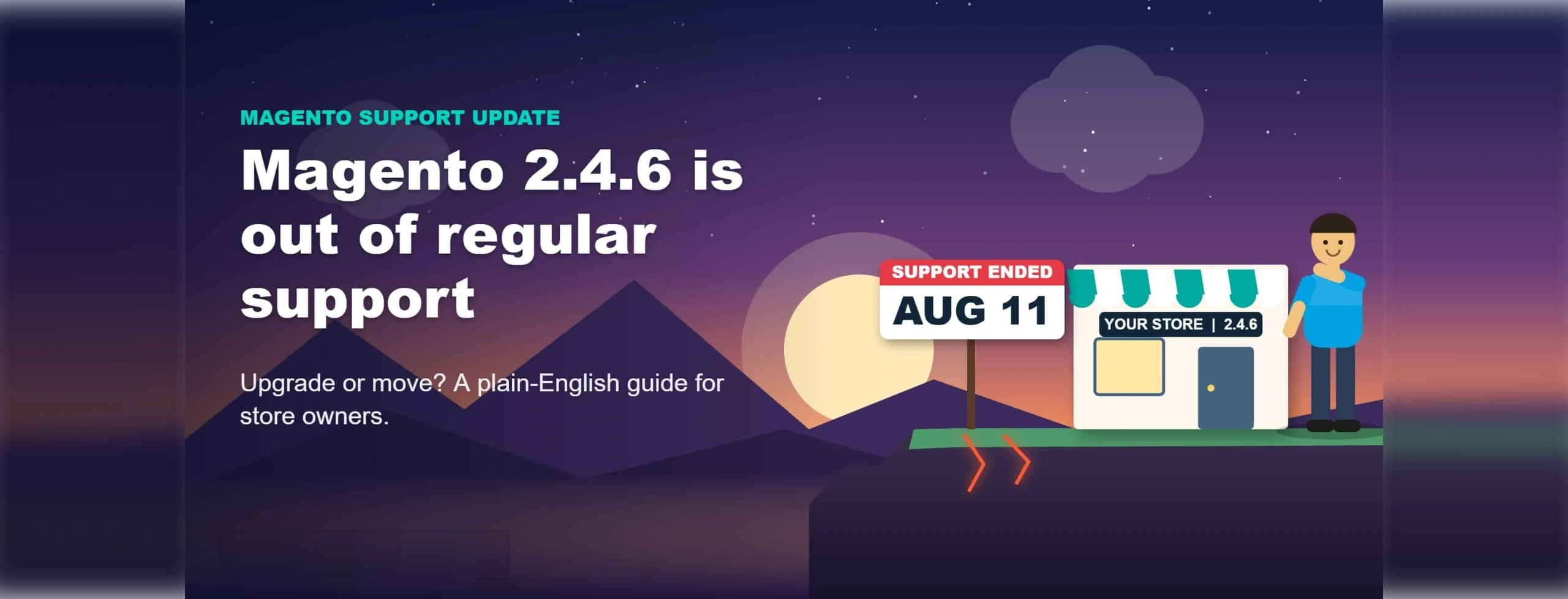
Staying on a supported version is the biggest ongoing challenge. Older releases such as 2.4.6 have left regular support, which leaves stores without regular security patches. If your store is behind, Magento upgrade services can bring it to a supported release safely.
Finding qualified, reliable support and maintenance can also be a hassle. Themes can break after updates, so you may need external developers to adjust the theme’s structure.
Why Choose Virtina for Magento eCommerce Development?
Building an eCommerce store on Magento is complex, and adjusting it to your business is vital. Do not hand a Magento development project to a freelancer without a team behind them. Integration, optimization, and customization all need meticulous planning, testing, and long-term maintenance.
You can trust a certified Magento company like Virtina. Our certified experts have delivered Magento projects across many industries, and our developers, designers, and managers understand different business types. Whether you need a new build, a migration, or Magento upgrade services to move to a supported release, we plan the roadmap with you.
Our Magento development company can help you with the following.
- Magento eCommerce development
- Magento extension development
- Magento Migration
- Magento Upgrade Services
- Magento theme development
- Custom Magento development
- Magento 2 module development
- Magento Performance Enhancement
- Magento Support and Maintenance
Magento eCommerce development is complicated, and Magento development can run into hurdles. You need a reliable partner for your project. We can create the right roadmap for your business and suggest the best solutions for your Magento eCommerce development needs.

Conclusion
Major brands such as Samsung, Nike, and Ford have trusted Magento, and thousands of active stores worldwide still run on it. In 2026 Magento remains one of the most dominant names in eCommerce, and it is the right choice for eCommerce store development when you pair it with a supported version, a modern storefront, and a reliable partner.
Magento supports every business type. It is reliable, secure, flexible, scalable, and high-performing, and the built-in features of Adobe Commerce support every facet of your business. The customer support and variety of apps are second to none.
The Magento ecosystem comes pre-loaded with the features a store needs to succeed, and the right Magento eCommerce development approach leads to more sales and revenue.
Ready to plan your next step? Explore our Magento upgrade services or talk to our Magento experts.
Frequently Asked Questions (FAQ)
Is Magento good for small business?
Yes, in many cases. Magento Open Source has no license fee and offers deep customization, so small businesses with development support can build a store that scales. Costs come from hosting, development, extensions, and maintenance, so compare total cost of ownership against platforms like Shopify or BigCommerce. If your catalog is simple, a hosted platform may be easier. If you expect complex products or B2B needs, Magento is a strong fit.
Why is Magento beneficial for eCommerce platforms?
Magento gives merchants control to build a store from scratch or customize it deeply. Its back office includes SEO tools, promotions, catalog management, and reporting, and it integrates with CRM, ERP, and marketing systems. That flexibility helps stores grow without outgrowing the platform.
Which are the best Magento platforms for your businesses?
Magento Open Source is the free, self-hosted edition and suits businesses with in-house or agency development support. Adobe Commerce (formerly Magento Commerce) adds advanced B2B tools, content staging, segmentation, and Adobe support, and is available self-managed, on Adobe’s cloud infrastructure, or as a cloud service. The right choice depends on your size, budget, and feature needs.
Is Magento 2.0 one of the best eCommerce platforms?
Magento 2 is the current generation of the platform, now delivered as 2.4.x releases such as 2.4.8 and 2.4.9. It offers flexibility, scalability, and performance for stores of all sizes, and remains one of the best choices for complex catalogs, B2B, and multi-store setups. Keep your store on a supported release for security and compatibility.
Specify the top features of Magento 2.0
Top features include a modular architecture, strong SEO controls, GraphQL and REST APIs, Page Builder, multi-store management, OpenSearch-powered search, B2B tools in Adobe Commerce, and a large marketplace of themes and extensions. This flexibility lets merchants build the product pages and buying experiences they want on any device.
Mention 5 ways a Magento website could help grow your business
A Magento website can help grow your business by delivering a fast, conversion-focused storefront, supporting B2B and B2C selling on one platform, scaling across products, stores, and currencies, connecting your ERP, CRM, and marketing tools, and giving you full SEO and content control. Extensions and themes let you extend the store without limits.
Is Magento an ideal platform for the B2B category?
Yes. Adobe Commerce includes company accounts with multiple users and roles, shared catalogs, custom pricing, quote requests, requisition lists, and quick order, along with strong integration, customization, and scalability. Magento Open Source can reach similar results with extensions and custom development.
Why Choose Magento Commerce, the enterprise-level platform?
Adobe Commerce is an enterprise-level platform with advanced B2B functionality, content staging, customer segmentation, rewards and loyalty, returns management, and Adobe support. It also offers cloud hosting options and a managed service for teams that want less infrastructure work. It is built for large catalogs, many users, and complex operations.
What are the special features of the Magento Commerce platform?
Magento Commerce is a robust platform for eCommerce with features to make selling online more dynamic and easier. You can let customers create their own rules-based related products, reward loyalty, or have access to special events just by logging into the site. With admin controls on who has permission over specific parts of your store like content staging areas in addition to shopping assistance options that help people find what they want quickly and easily when browsing through thousands of items available at any given time!