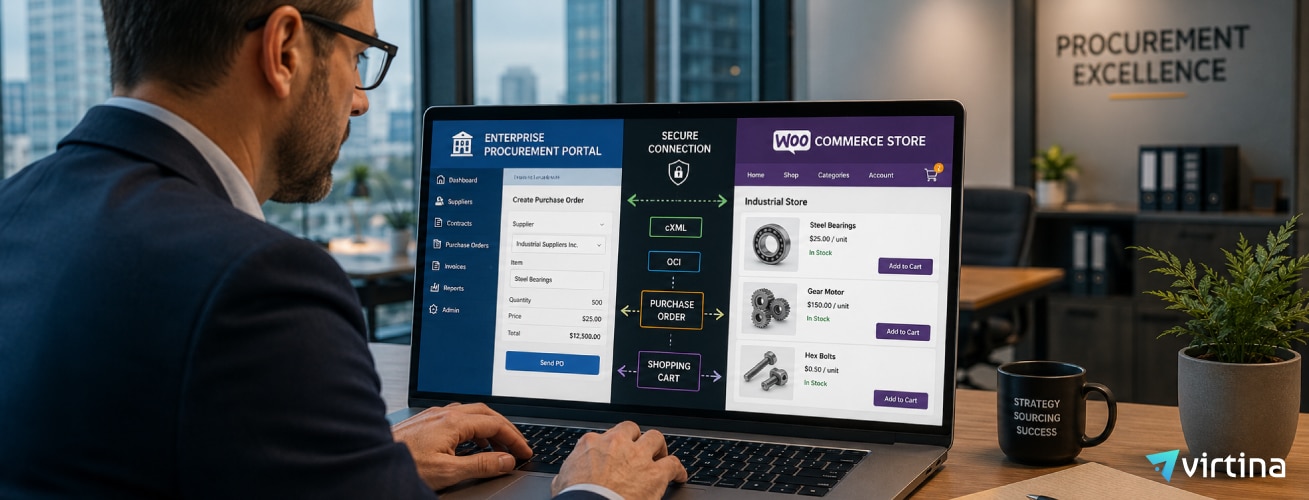
Summary
AI shopping agents are now a mainstream customer acquisition channel. In 2025, 61% of American adults used AI for shopping, and Adobe recorded 693% growth in AI-sourced retail traffic.
Most stores are invisible to these agents because of JavaScript-rendered prices, incomplete schema, and accidentally blocked crawlers. This guide explains what agent-ready means, how it differs from GEO, and the 10-step audit to fix it.
Introduction
A buyer asks ChatGPT to find the best industrial pump under $500 and order it. Your store carries that product, but prices load via JavaScript, GTIN fields are empty, and GPTBot is blocked. The agent visits, gets an empty page, and moves on to a competitor.
This is not a future problem. Shopify data shows AI-driven orders grew 15x year over year since January 2025. Adobe found AI-referred shoppers converted 31% more, bounced 33% less, and that revenue goes to stores that are readable to agents.
There is a distinction worth making. ChatGPT can cite your store as a recommendation, and that same agent can still fail to buy from you. Citation and transaction are two different problems, and this post covers both.
Table of Contents
- What does “agent-ready” mean for an ecommerce store?
- What is the difference between GEO and being agent-ready?
- How do AI shopping agents find and evaluate products?
- What is Google’s Universal Commerce Protocol (UCP)?
- Why isn’t my store showing up in AI shopping results?
- What makes a product page invisible to AI shopping agents?
- Do I need structured data for AI shopping agents?
- How do I optimize my product data for AI agents?
- What is the difference between training crawlers and retrieval bots?
- How do I make my ecommerce store agent-ready?
- People also ask
- Conclusion
- Frequently asked questions
What does “agent-ready” mean for an ecommerce store?
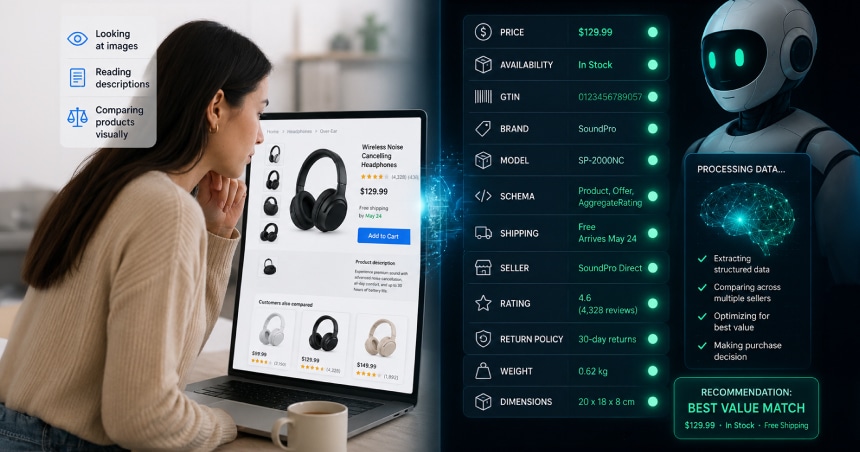
Agent-ready means an AI agent can read your store, compare products, and complete a purchase with no human involved. Mobile-ready and SEO-ready optimize the experience for a human visitor. Agent-ready optimizes the data layer for a machine acting on a buyer’s behalf.
A human customer can read a price rendered by JavaScript, solve a CAPTCHA, and tolerate a slow page. An AI shopping agent cannot. It fetches static HTML, reads structured data fields, checks real-time availability, and transacts or moves on in seconds.
A buyer asks ChatGPT to find the best industrial air compressor under $500. ChatGPT visits 12 product pages: eight return usable data, four return a spinner with no price, and your store is one of the four. The AI features already reshaping ecommerce have made agent-readiness a baseline requirement, not an advanced optimization.
What is the difference between GEO and being agent-ready?
GEO means AI mentions your content in its responses. Agent-ready means AI can execute a purchase from your store. These are different problems: GEO is a discoverability issue, and agent-readiness is a transaction infrastructure problem.
Here is the gap in practice: ChatGPT says “Buy from Acme Tools,” which is a GEO win. But if Acme’s page renders prices via JavaScript and blocked OAI-SearchBot, the agent cannot buy from Acme. GEO gets the mention, but agent-readiness closes the sale.
Most store operators start by fixing how schema gaps filter you out of AI results, but schema alone bridges only half the gap. The transaction half requires server-side rendering, real-time inventory data, and a checkout path an agent can complete.
How do AI shopping agents find and evaluate products?
AI shopping agents find products through three channels: crawling product pages, reading Merchant Center feeds, and consuming structured data in page HTML. Each channel is a gate. Fail one, and you may lose a specific agent entirely.
Four major agents dominate in 2026. ChatGPT Shopping reaches 900 million weekly users, and Google AI Mode crossed 1 billion monthly users in May 2026. Perplexity Shopping has 45 million monthly users, and Amazon Rufus served 300 million customers in 2025.
Google AI Mode leans on Merchant Center feed data. Perplexity Shopping reads schema markup and requires GTINs. ChatGPT Shopping uses product page schema plus Merchant Center data where available.
Some agents, like ChatGPT agent, skip cached data and browse live pages directly. Either way, if your page returns no readable data, your store is invisible. Maintaining clean product data connected to your ERP is what keeps you in contention.
What is Google’s Universal Commerce Protocol (UCP)?
Google’s Universal Commerce Protocol (UCP) is an open standard that lets AI agents discover what a store sells, run checkout and take payment in one standardized flow. Google announced it on 11 January 2026, built with Shopify, Etsy, Wayfair, Target and Walmart and backed by more than 20 partners, including Adyen, American Express, Best Buy, Stripe and Visa.
UCP powers buying inside AI Mode in Google Search and the Gemini app. A store publishes a manifest at /.well-known/ucp that tells agents which capabilities and payment options it supports, and payments run through Google’s Agent Payments Protocol (AP2).
How do you get your store ready for UCP?
- Merchant Center. An active Google Merchant Center account with eligible, complete product listings.
- Matching product data. Product schema and GTINs on the page that match your feed, so Google trusts both.
- Checkout integration. A checkout that follows Google’s UCP integration guide. Shopify stores get this through the platform. WooCommerce had no built-in UCP support as of August 2026, so it needs custom work.
What changed with ChatGPT checkout in 2026?
OpenAI launched Instant Checkout in ChatGPT in September 2025, built on the Agentic Commerce Protocol it developed with Stripe. In March 2026 it retired Instant Checkout. ChatGPT now helps shoppers find and compare products, then sends them to buy on the merchant’s own site.
That puts your product page and your own checkout back at the point of sale. A shopper who arrives from ChatGPT needs a page that loads fast, shows the price and stock clearly, and lets them buy without friction. Our agentic commerce services cover UCP setup, Merchant Center feeds and checkout readiness.
Why isn’t my store showing up in AI shopping results?
Your store likely isn’t showing up because of a missing Merchant Center feed, structured data errors, or blocked retrieval bots. Any one of those removes you from results entirely. Together, they make your store completely invisible to AI shopping agents.
The scale of what you’re missing is real. Adobe recorded 693% growth in AI-sourced retail traffic in the 2025 holiday season. Shopify reports 15x YoY growth in AI-driven orders, and AI-referred shoppers convert 31% higher and bounce 33% less.
Consider a mid-market industrial parts store with solid Google rankings. When a Perplexity Shopping agent fetched that SKU, the page returned an empty shell: prices were React-rendered and invisible to the crawler. The agent moved to a lower-ranked competitor whose prices were server-side rendered.
Understanding standard SEO fundamentals is necessary but not sufficient. Agent-readiness adds a technical layer that standard SEO does not cover.
What makes a product page invisible to AI shopping agents?
Three failure modes make a product page invisible to AI agents. JS-rendered prices, missing Product schema, and blocked bot names in robots.txt account for most cases where an agent skips a store it could otherwise convert.
JavaScript rendering is the most common failure: four of six major AI crawlers fetch static HTML only and do not execute JavaScript. A React or Vue product page returns a blank shell to the crawler. Server-side rendering for price and availability is the fix.
Missing GTIN fields are the second most common failure. Perplexity Shopping requires GTINs to list products, and Google AI Mode uses GTIN to cross-reference Merchant Center data with on-page schema. A product without a GTIN is deprioritized or skipped.
Checkout barriers are the third failure class. Login walls, CAPTCHA triggers, and viewport-blocking cookie banners stop agents at the point of purchase. Treating your store as an engineering problem, not a marketing one means addressing these as blocking bugs.
Agent-ready audit: check these 6 things today
- Robots.txt check. Open your robots.txt and search for GPTBot, OAI-SearchBot, and PerplexityBot. Confirm retrieval bots are listed as allowed.
- JS rendering check. Disable JavaScript in your browser on a product page. If price and stock disappear, AI crawlers see the same blank state.
- Schema.org validation. Run 3 product URLs through Google’s Rich Results Test. Check for missing GTIN, priceCurrency, and availability.
- Merchant Center feed. Log in to Google Merchant Center and check your attribute completeness score. 99.9% completion gives 3-4x higher AI Mode visibility.
- Checkout friction test. Open incognito and attempt checkout without an account. If blocked, agents will fail here too.
- Product API response. Can your store return price, availability, and shipping for a SKU in under 200ms? If not, real-time agents will skip your store.
Do I need structured data for AI shopping agents?
Yes. Schema.org Product markup with Offers, GTIN, and availability is the minimum for AI agents to read your product data. Without it, agents skip your pages or rely on best-guess parsing of unstructured HTML.
The required fields are: name, sku, gtin, offers (price, priceCurrency, availability), image, brand, and aggregateRating. For stores that want agents to complete transactions, also add OfferShippingDetails, hasMerchantReturnPolicy, and ProductGroup for variant products. The Schema.org Product specification is the definitive reference.
JSON-LD is the preferred format: place it in the page head, server-side rendered, never JavaScript-injected. 65% of pages cited by Google AI Mode include structured data. Investing in a structured data implementation now is cheaper than retrofitting after AI traffic is already routing around you.
How do I optimize my product data for AI agents?
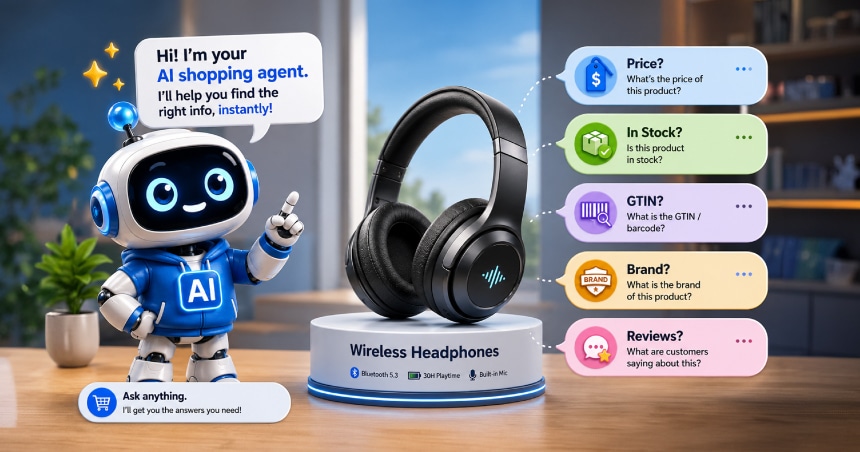
Start with clean product titles, complete descriptions without AI-generated filler, and valid JSON-LD schema on every product page. These three changes produce the most immediate improvement in agent readability.
The optimizations that move the needle:
- Product title format. “DeWalt DCD771C2 20V Max Cordless Drill Driver Kit” is machine-readable. “Cordless Drill Kit” is not. Use brand + model + key spec in every title.
- Price as static HTML text. Price must be visible in page source before JavaScript runs. Confirm by viewing page source, not DevTools.
- In-stock signals. Availability must be explicit in schema: schema.org/InStock or schema.org/OutOfStock. Never leave the field blank.
- Google Merchant Center feed. Submit a complete feed and maintain 99.9% attribute completion. This is the primary data source for Google AI Mode.
- llms.txt file. Create a plain-text file at yoursite.com/llms.txt pointing to your product feed URL and sitemap. Fewer than 1,000 domains had published one as of July 2025.
- Review markup. Add AggregateRating to every product page. AI agents use review counts as a proxy for product reliability when comparing options.
B2B catalog data standards require an even higher bar. B2B product pages carry complex attribute sets: compatibility ranges, certifications, industry classifications. These need explicit schema fields, not buried description text.
What is the difference between training crawlers and retrieval bots?
Training crawlers collect data to build AI models. Retrieval bots fetch real-time data to answer user queries right now. Blocking them together is the mistake most store operators made between 2024 and 2026.
Training crawlers (GPTBot, ClaudeBot, Google-Extended, Meta-ExternalAgent) crawl the web to build model training data. Blocking them has zero effect on whether ChatGPT or Perplexity shows your products to shoppers today.
Retrieval bots (OAI-SearchBot, PerplexityBot, Claude-SearchBot, standard Googlebot) power real-time AI answers and shopping results. Blocking any of them removes you from that agent’s results immediately.
Many SEO plugins added “block AI bots” toggles in 2024 and 2025, enabled by default. Stores activated these thinking they were stopping training scrapes, but instead blocked retrieval bots and vanished from AI results overnight. The B2B buyers now evaluating suppliers through AI agents depend on exactly those bots.
How do I make my ecommerce store agent-ready?
Start with these 10 items in order. This is your agent-ready audit.
- Confirm GPTBot and OAI-SearchBot are not blocked in robots.txt.
- Confirm PerplexityBot and Google-Extended directives are correct: allow PerplexityBot, optionally restrict Google-Extended for training only.
- Validate Product schema on 5 random product pages using Google’s Rich Results Test.
- Add GTIN and MPN fields to schema on every product page where identifiers exist.
- Make price and availability visible as static HTML text before JavaScript runs.
- Submit or verify your Google Merchant Center product feed. Check attribute completeness.
- Add brand + model + key spec to every product title.
- Set up AggregateRating markup on product pages.
- Create or verify a site search API endpoint that returns price, stock, and shipping for any SKU in under 200ms.
- Create an llms.txt file at your site root pointing to your product feed URL and product sitemap.
The fastest wins are items 1, 2, 5, and 7: no new development required. Schema fixes (3, 4, 8) and feed work (6) take longer but produce the largest visibility gains. A typical mid-market store completes the full list in two to four weeks.
Start with your B2B product catalog and customer portal to identify data gaps before writing a single schema line. Virtina helps WooCommerce, Magento, Shopify, and BigCommerce stores work through this checklist systematically through our agentic commerce services.
People also ask
What is the difference between AI search and an AI shopping agent?
AI search returns information to a human who then acts on it. An AI shopping agent acts on behalf of the human directly, browsing pages, comparing products, and placing the order. The difference is who takes the final action.
Can AI agents buy on my behalf?
Perplexity Shopping’s “Buy with Pro” and Amazon Rufus both complete purchases today. ChatGPT’s Instant Checkout launched in September 2025 but was retired in March 2026, so ChatGPT now sends shoppers to buy on the merchant’s own site. Google’s Universal Commerce Protocol runs checkout inside AI Mode and the Gemini app. The infrastructure is live, not theoretical.
How do I test if an AI agent can read my product pages?
Disable JavaScript in your browser and reload a product page: if price and stock disappear, AI crawlers see the same empty state. Run a product URL through Google’s Rich Results Test and check for GTIN and complete Offer fields. Then search for that product in Perplexity Shopping; all three tests take under 15 minutes.
What structured data do I need for Google AI Mode?
Google AI Mode uses your Merchant Center feed as the primary source and on-page Product schema as verification. Required fields are name, brand, sku, gtin, image, price, priceCurrency, and availability. Mismatches between schema and Merchant Center data cause Google to deprioritize both.
Conclusion
AI shopping agents are now a real customer acquisition channel. Adobe’s 693% traffic growth and Shopify’s 15x order growth came from a single holiday season. Stores that close the agent-readiness gap in 2026 will have a structural advantage going into 2027.
The 10-step checklist in this post is your starting point. robots.txt, schema, Merchant Center feed, SSR, and llms.txt are all within reach for any ecommerce store. Contact Virtina to run the audit and prioritize the fixes for your specific stack.
Frequently Asked Questions
What is agentic commerce?
Agentic commerce is the model in which AI agents act as autonomous buyers on behalf of human users. The agent receives a brief, browses stores, compares options, and completes the purchase. Two open standards now shape how agents transact at merchant stores: the Agentic Commerce Protocol (ACP) from OpenAI and Stripe, and Google’s Universal Commerce Protocol (UCP), launched in January 2026.
Does my store need to be on Shopify or a specific platform to be agent-ready?
No. Agent-readiness depends on your technical setup, not your platform choice. WooCommerce, Magento, BigCommerce, and Shopify all support SSR prices, Product schema with GTIN, Merchant Center feeds, and correct robots.txt. The checklist is the same regardless of which platform you run.
What is llms.txt and do I need it?
llms.txt is a plain-text file at yoursite.com/llms.txt giving AI crawlers a path to your product feed, sitemap, and data endpoints. It had fewer than 1,000 adopters globally as of July 2025. Implement it now for early-mover advantage, but it does not replace schema or Merchant Center feeds.
How do I check if AI bots are blocked on my site?
Go to yoursite.com/robots.txt and search for GPTBot, OAI-SearchBot, PerplexityBot, and Claude-SearchBot. If any appear under Disallow: /, that bot is blocked from your store entirely. Also check your SEO plugin settings: many added default-on block AI crawlers toggles in 2024-2025.
How long does it take to make a store agent-ready?
For a typical mid-market store with 100-500 SKUs, the core work takes two to four weeks. robots.txt fixes and SSR price changes happen in a day or two.
Schema markup with complete fields typically takes one to two weeks. Merchant Center feed work varies by how far the current feed falls from 99.9% attribute completion.
Do AI agents actually complete purchases or just make recommendations?
ChatGPT now recommends products and sends shoppers to your store to buy, after OpenAI retired Instant Checkout in March 2026. Google AI Mode and the Gemini app can complete checkout with merchants that support Google’s Universal Commerce Protocol, and Perplexity’s Buy with Pro completes purchases too. The proportion of agents completing end-to-end purchases is growing.
What is the difference between a Google Shopping feed and being agent-ready?
A Google Shopping feed is one component of agent-readiness, not the whole picture. Your Merchant Center feed supplies Google AI Mode with data, but schema, SSR prices, and correct robots.txt are also required. A complete feed paired with blocked crawlers and JS-rendered prices still produces invisible product pages for most AI shopping agents.
Will being agent-ready hurt my regular SEO?
No. Every change required for agent-readiness aligns with standard SEO best practices. Server-side rendering improves Google crawlability, schema markup improves rich result eligibility, and correct robots.txt does not affect standard Googlebot. Agent-readiness extends your existing SEO work into a new channel.
Virtina eCommerce strategy team: Virtina’s certified eCommerce experts have helped 1,000+ B2B and B2C brands across manufacturing, distribution, retail, and wholesale. With 14+ years and 2,000+ projects delivered, Virtina is a WooCommerce Expert, Magento Certified, Shopify Partner, and BigCommerce Partner.